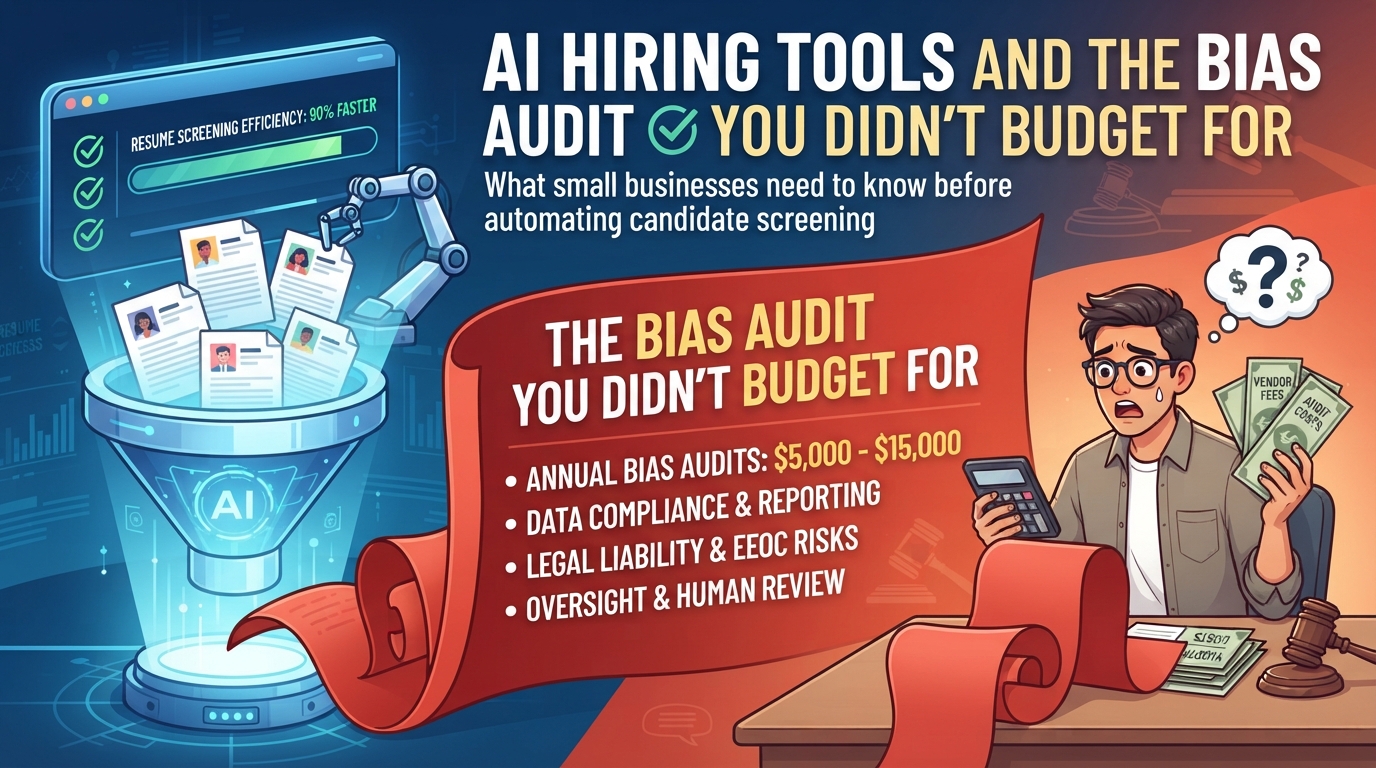
AI hiring tools and the bias audit you didn't budget for
AI hiring tools and the bias audit you didn't budget for
What small businesses need to know before automating candidate screening
The decision
You're looking at AI-powered hiring tools because recruiting takes too much time or you want to reduce labor costs. A vendor has shown you a demo where resumes get sorted in seconds instead of hours. The pitch is straightforward: automate candidate screening, cut recruiter hours, hire faster.
But the decision isn't whether AI can read resumes faster than humans. It can. The decision is whether you can operate an AI hiring system in a way that meets your legal obligations, produces better hires than your current process, and actually costs less when you account for everything required to run it properly.
Here's what changes when you automate hiring decisions. You become responsible for bias audits. You must notify candidates that AI is screening them. You need documented processes for human review. You have to explain automated rejections if challenged. The EEOC applies Title VII disparate impact standards to AI hiring tools, which means you're liable for discriminatory outcomes even if you didn't intend them. In New York City, Local Law 144 requires annual bias audits and candidate notices before you can use automated employment decision tools. Other jurisdictions are following.
The real decision is this: can you handle the compliance work, do you have enough hiring volume to justify the cost, and will this actually improve your hiring outcomes? If you hire 8 people per year, the answer is almost certainly no. If you hire 80 and struggle with consistent screening quality, maybe. The tool itself is the easy part. Everything around it is where small businesses get stuck.
Why the offer looks attractive
The demo is impressive. Upload a hundred resumes, get a ranked list in minutes. The vendor shows you how their system identifies qualified candidates faster than any human could read the applications. They'll tell you this eliminates bias because machines don't have prejudices. They'll say it saves 70-80% of screening time. They'll show you a dashboard with metrics.
For a small business owner doing their own recruiting or paying someone hourly to screen applications, the time savings look real. If you're spending 10 hours per week reviewing resumes during hiring season, getting that time back feels like finding money. The vendor will calculate an ROI based on your hourly rate times hours saved. The math looks clean.
The promise of eliminating human bias is particularly appealing. You've read about discrimination lawsuits. You want to be fair. A vendor telling you their algorithm is objective sounds like protection. They'll emphasize that machines don't care about names, ages, or schools. They'll say the system ensures EEOC compliance automatically, which sounds like it removes legal risk rather than creating new obligations.
The implementation pitch is usually light. Minimal IT resources required. Works with your existing systems. No special training needed. You can be up and running in days, not months. For a business that doesn't have an IT department, this matters. The vendor makes it sound like you're buying a tool, not taking on a compliance program. That's the part that causes problems later.
What the vendor emphasizes
Vendors lead with time savings because that's what gets attention. They'll show you before-and-after scenarios where screening time drops from 40 hours to 6 hours per hiring cycle. They emphasize speed and volume handling. The message is that you can process more candidates better than you do now, which sounds like you'll find better people faster.
They talk about eliminating bias, but what they mean is eliminating one type of conscious bias in the initial screening step. The claim is that algorithms don't see race, gender, or age, so they can't discriminate the way humans might. This sounds protective. What they don't emphasize is that algorithms can absolutely produce discriminatory outcomes by learning from biased historical data or using criteria that correlate with protected characteristics.
Vendors will tell you their platform ensures compliance, but they mean the platform has features that could support compliance if you use them correctly. They're not taking on your legal liability. Vendor benchmarks typically report 70-90% precision, but these numbers come from controlled tests, not your specific hiring context. The accuracy you get depends on your data quality and how well the system is configured for your roles.
The implementation story is always simple. Upload your job descriptions, connect your applicant tracking system, and start screening. They'll minimize the data preparation work, the testing period, the training required for your team, and the ongoing oversight needed. They want you focused on the efficiency gain, not the operational requirements. Too many teams have spent six months integrating something they didn't need because the demo made it look effortless.
What the buyer may be overlooking
Hidden compliance obligations. New York City's Local Law 144 requires annual bias audits for AI hiring tools, and similar regulations are emerging in other jurisdictions. These audits cost $5,000-$15,000 annually and require enough hiring volume in each job category to produce statistically meaningful results. You must also notify candidates that AI is screening their applications and provide alternative accommodation processes. Most small businesses discover these requirements after signing contracts.
The data quality trap. AI hiring tools need clean historical data to learn what "good" looks like. A 2024 analysis found that biased historical hiring patterns get encoded into algorithms - if your past hiring favored certain demographics due to network effects or unconscious bias, the AI will perpetuate those patterns. One small professional services firm implemented an AI screening tool only to discover their historical data showed they'd never hired parents with employment gaps, which the algorithm learned to replicate until flagged in their first bias audit.
Oversight doesn't decrease over time. Vendors emphasize time saved in initial screening but downplay the permanent requirement for human review of edge cases, candidate appeals, and algorithm decisions that don't align with business judgment. A small manufacturing company found they spent 12 hours weekly reviewing automated decisions in month one, expected this to decrease, but were still spending 8-10 hours weekly in month twelve as they encountered new edge cases and role variations.
Volume requirements you may not meet. Bias audits require enough hiring activity in each job category to detect discrimination patterns statistically. If you hire 2-3 accountants, 1-2 sales people, and 3-4 warehouse workers annually, you don't have the volume needed for meaningful audit results. You're paying for compliance theater rather than actual bias detection.
The algorithm update problem. When vendors update their algorithms, your previous bias audit results become obsolete. You have no control over when updates occur, no advance testing capability, and no liability protection if an update introduces new bias patterns. You discover problems only after candidates are affected.
What must be true internally
You need a structured, repeatable hiring process before you automate anything. If your current approach is ad hoc - different criteria for each role, inconsistent interview questions, no documented decision rationale - automation will just scale the inconsistency. Follow a structured recruitment checklist covering preparation, candidate selection, and onboarding before you think about AI. You should be able to describe your hiring process the same way every time.
You need someone who owns this. Not just uses it, but owns the compliance obligations, manages the vendor, monitors for problems, and handles escalations. That person needs to understand both your hiring needs and the legal requirements. They need authority to stop using the tool if it's not working. If you're thinking "I'll just set it up and let it run," you're setting yourself up for problems you won't see until they're expensive.
You need clean historical data or the willingness to start fresh without it. The algorithm needs examples of good hires and bad hires to learn from. If you can't provide that, you're asking the vendor to configure the system based on generic assumptions about your roles. That rarely works well. And if your historical data reflects biased decisions, the algorithm will learn the bias. You can't fix a biased hiring process by automating it.
You need enough hiring volume to justify the fixed costs. Bias audits, vendor fees, system maintenance, and oversight don't scale down for small businesses. If you hire 5 people per year, you're spreading those costs across 5 hires. The math doesn't work. You need at least 30-50 hires annually to make the economics sensible, and even then it's marginal unless you're struggling with quality or consistency at that volume.
You need a fallback process for when the automation fails or produces questionable results. What happens when the system rejects someone who looks obviously qualified? What happens when it can't parse a resume format? What happens when a candidate asks why they were rejected? You need documented answers and the capacity to execute them. Automation doesn't eliminate judgment. It changes where judgment happens.
Total cost considerations
Software and subscription costs. Vendor fees range from $200-$800 per month ($2,400-$9,600 annually) depending on hiring volume and features. Some vendors charge per candidate screened ($2-$5 per application) or per hire ($200-$500), creating unpredictable costs during high-volume periods. Budget for the high end of the range.
Compliance and audit costs. Annual bias audits cost $5,000-$15,000 depending on the number of job categories and complexity of your hiring data. Candidate notification systems, alternative accommodation processes, and documentation for regulatory compliance add $1,000-$3,000 annually in administrative overhead. These are mandatory, not optional.
Implementation and integration. Data preparation, system configuration, integration with existing applicant tracking systems, job description standardization, and initial testing require 40-80 hours of internal time. At realistic billing rates of $50-$75 per hour, budget $2,000-$6,000 in first-year labor costs. This doesn't include vendor professional services if required.
Training and change management. Initial training requires 8-12 hours per person for anyone involved in hiring decisions. For a small business with 3-4 hiring managers, budget $1,000-$2,000 in first-year training costs and $500-$1,000 annually for ongoing training as staff turns over.
Ongoing oversight and vendor management. Human review of automated decisions, edge case investigation, candidate escalations, and system monitoring require 5-10 hours per month at $30-$50 per hour, totaling $1,800-$6,000 annually. This is permanent operational cost that doesn't decrease as you gain experience.
Worked example for a 50-person company hiring 30 people annually:
Software: $400/month × 12 = $4,800
Annual bias audit: $8,000
Implementation (first year only): $4,000
Training (first year): $1,500
Ongoing oversight: $3,600
Candidate notification compliance: $1,500
First-year total: $23,400 ($780 per hire)
Ongoing annual: $17,900 ($597 per hire)
Compare this to a traditional applicant tracking system at $200/month ($2,400 annually, $80 per hire) with no compliance overhead, or to documented process improvements costing only staff time to develop templates and training materials.
Questions to ask the vendor
About the algorithm and decision-making:
"What specific hiring decisions does your AI make autonomously versus flagging for human review?"
"What data does your algorithm use to rank candidates, and can I review the actual criteria?"
"How was your algorithm trained, and what historical data did you use?"
"When you update or retrain your algorithm, who tests it for bias before deployment, and who is liable if an update introduces discrimination that affects my candidates?"
About compliance and auditing:
"Do you provide the bias audit, or do I need to hire an independent auditor?"
"What candidate volume do I need in each job category for a statistically valid bias audit?"
"What happens if a bias audit reveals adverse impact - what's your remediation process and timeline?"
"Do you handle candidate notification requirements, or is that my responsibility?"
About costs and contract terms:
"What's included in the base price versus additional fees for audits, support, or integrations?"
"How do you charge for high-volume hiring periods - flat fee or per-candidate?"
"What's the contract term and cancellation policy if the tool doesn't work for our hiring patterns?"
"What happens to our data if we cancel - can we export it for our own bias analysis?"
About accuracy and performance:
"What's your false negative rate - how many strong candidates does the system typically screen out?"
"Can you provide references from companies in our industry with similar hiring volume?"
"What percentage of your customers are still using the tool after 12 months?"
"What candidate appeals process do you support, and how often do appeals overturn automated decisions?"
About implementation and support:
"What integrations are included versus requiring custom development?"
"How long does typical implementation take for a company our size?"
"What ongoing support is included - response times, dedicated contact, or ticket system?"
"Do you provide training materials, or do we need to develop our own?"
Go or no-go criteria
Go if you hire at least 30-50 people per year and struggle with screening consistency. The fixed costs of automation and compliance make sense at this volume if your current process produces uneven results. Go if you have clean historical hiring data showing who was hired, who was rejected, and why—or if you're willing to start fresh and build that data set intentionally over 6-12 months before expecting the system to perform well.
Go if you have budget for annual bias audits and ongoing oversight, not just the software fee. Go if you have someone who can own this operationally and handle compliance obligations. Go if you can document your current hiring process clearly enough that you could train someone else to do it the same way. If your process is already structured, automation might make it faster. If your process is chaotic, fix the chaos first.
No-go if you hire fewer than 20 people per year. The economics don't work. You'll spend more on the tool and compliance than you'll save in efficiency. No-go if your historical hiring data is messy, inconsistent, or potentially biased and you don't have the capacity to clean it up. No-go if you can't afford annual bias audits or don't have someone who can manage vendor compliance.
No-go if you're trying to solve a labor cost problem by eliminating recruiter hours. Automation doesn't eliminate the work. It changes the work. If you're hoping to cut a part-time recruiter and replace them with software, you're underestimating the oversight required. No-go if your hiring process isn't documented or repeatable. Automating a broken process makes it broken faster.
Conditional proceed if you're in between. You have enough volume to justify the cost, but you need to fix your process first. You have historical data, but it needs cleaning. You have budget, but you need to test whether the tool actually improves outcomes before committing long-term. In that case, document your current process completely, measure your current cost per hire and time-to-hire, then run a small pilot with one role type and compare the results. Don't scale until you have proof it works for your specific context.
Recommended next action
Document your current hiring process before you talk to any vendor. Write down every step from job posting to offer letter. Note how long each step takes and who does it. Identify where you're inconsistent. Identify where you're spending the most time. Identify where you're making the most mistakes. This takes about 4-6 hours if you're honest about it.
Then calculate your current cost per hire. Include posting fees, staff time at realistic hourly rates, interview time, background checks, and onboarding. Measure this over the last 12 months. You need a real baseline, not a guess. If you don't know what hiring costs you now, you can't evaluate whether automation will save money.
Next, look at your hiring volume and quality. How many people did you hire last year? How many of those hires worked out well versus poorly? What patterns do you see in successful versus unsuccessful hires? If you're hiring 8 people per year and 7 of them are great, your problem isn't screening efficiency. If you're hiring 40 people per year and struggling to maintain consistent quality, automation might help.
If your volume is above 30 hires per year and you have documented process problems, then talk to vendors. But go into those conversations with your process map, your cost per hire, and your quality metrics in hand. Ask the questions from the previous section. Don't sign anything until you've talked to at least three references who are actually small businesses.
If your volume is below 30 hires per year, or if your process is undocumented and inconsistent, fix the process first. Standardize your job descriptions. Create interview scorecards. Train your hiring managers. Implement structured interviews. These improvements will cost you almost nothing and deliver immediate results. You can always automate later once you have a process worth automating. Starting with automation when your process is broken just makes the problems harder to see and more expensive to fix.