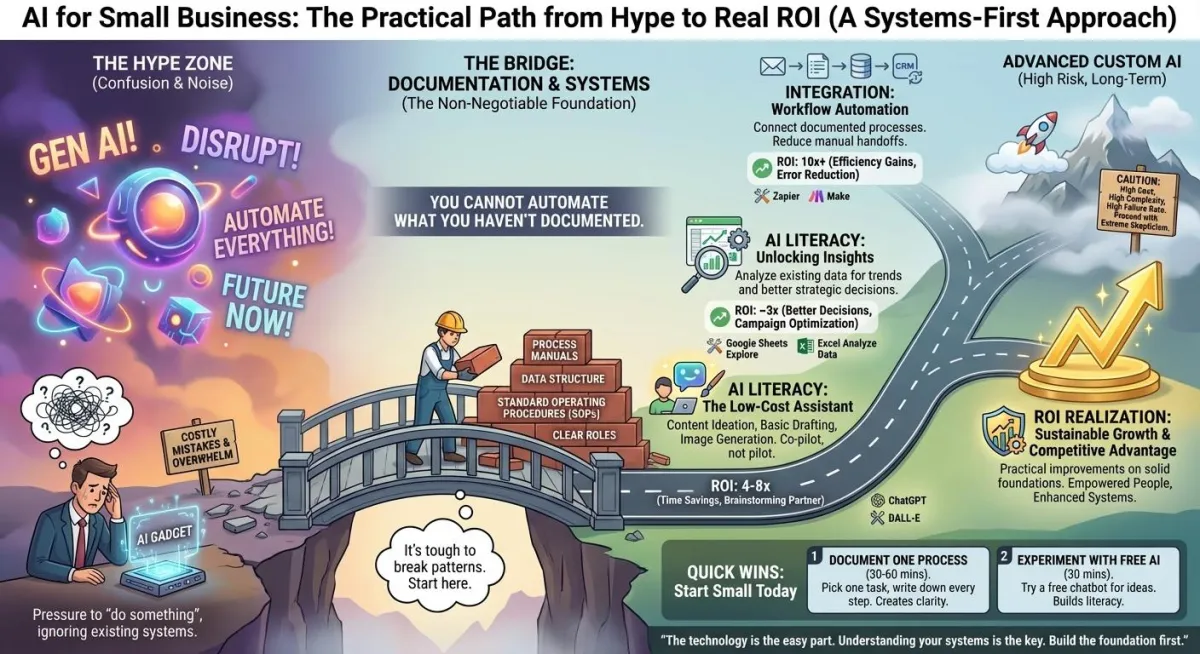
Beyond the Hype: Building AI-Ready Systems for Sustainable Growth
Alright, fellow business owners and operational wizards. It's December 26th, 2025, and if you're like me, you're probably already thinking about how to hit the ground running in the new year. The AI buzz is louder than ever, and I know many of you are feeling the pressure to 'do something' with it. I've been through enough technology cycles – the dot-com boom, the mobile revolution, the cloud shift – to know that every new wave brings both incredible opportunity and a whole lot of noise.
Here's the truth: Your brain, just like mine, is wired for the systems and processes you've honed over years, maybe even decades. You've built your business on these foundations, and they've served you well. So, when someone throws a shiny new AI tool at you and says 'automate everything!', it's natural to feel a mix of excitement and overwhelm. It's tough to break those ingrained patterns, to retrain your thinking, and to see how a new piece of tech fits into the operational rhythm you've perfected. This isn't a failing; it's just human nature and the reality of running a lean operation.
My job, as I see it, isn't to sell you the latest gadget. It's to help you navigate this landscape, to protect you from costly mistakes, and to guide you towards practical, ROI-driven improvements. We're going to talk about AI, yes, but always through the lens of your existing systems. Because, and I can't stress this enough, you cannot automate what you haven't first documented. That's a lesson I've learned the hard way more times than I care to admit.
Which statement best describes your current operational processes?
A. Most of our critical processes are in people's heads or loosely defined.
B. We have some documented processes, but they're not always consistently followed or up-to-date.
C. Our key operational processes are well-documented, regularly reviewed, and consistently executed by the team.
Solutions by Implementation Level
Your Personal AI Brainstorming Partner: ChatGPT for Content & Ideas
AI Literacy
Before you think about complex integrations, let's start with the basics: leverage AI as a powerful, low-cost assistant for ideation and content generation. This isn't about replacing your creative team; it's about giving them a tireless brainstorming partner. Think of it as a systematic way to generate first drafts, analyze market data snippets (once you feed it), or outline communication strategies. The system here is your content creation workflow – this tool just supercharges the initial steps.
Timeline: 1-2 hours to learn basics, ongoing 30 mins/day for consistent use
Cost: $20/month (for ChatGPT Plus) + 1 hour setup for account
ROI: Saves 5-10 hours/month on content drafting, brainstorming, and research. At $30/hour, that's $150-$300/month savings, easily 7x ROI.
Failure Rate:10% if users don't learn effective prompting; 5% if they expect perfect output without human refinement.
Action Steps:
Identify 2-3 recurring content tasks (e.g., social media posts, blog outlines, email drafts) that take significant time.
Sign up for ChatGPT Plus (or a similar premium AI chatbot).
Spend 1-2 hours experimenting with prompts, focusing on your identified tasks. Try asking for 5 different headlines, a blog post outline on a specific topic, or ideas for a customer FAQ.
Integrate its output as a first draft into your existing content review process. Remember, it's a co-pilot, not the pilot.
Recommended Tools:
Google Gemini Advanced $19.99/month
Protective Warning:Don't blindly publish AI-generated content. It needs human review for accuracy, tone, and brand voice. Plagiarism checks are essential. The biggest mistake is treating it as a 'set it and forget it' solution rather than a tool to enhance human output. Your unique voice is your brand; AI is a megaphone, not the singer.
Visual Storytelling Made Easy: AI Image Generation for Marketing
AI Literacy
For small businesses, high-quality visuals for marketing, presentations, or internal communications can be a bottleneck. Professional graphic design is expensive, and stock photos can feel generic. AI image generators can systematically reduce this friction, allowing you to create custom visuals quickly and affordably. This fits into your marketing content creation system, speeding up the visual asset generation phase.
Timeline: 2-3 hours to learn basic prompting, 1 hour/week for creating assets
Cost: $10-$30/month (for DALL-E 3 via ChatGPT Plus or Midjourney) + 2 hours setup
ROI: Saves 4-8 hours/month on finding/creating visuals, plus potential savings on stock photo subscriptions or freelance designers. At $30/hour, that's $120-$240/month savings, a clear 4-8x ROI.
Failure Rate:15% if users expect photorealistic perfection on first try; 5% if they don't understand ethical use or copyright.
Action Steps:
Identify specific needs for custom images (e.g., blog headers, social media graphics, internal presentation slides).
Choose an AI image tool (DALL-E 3 via ChatGPT Plus is accessible).
Experiment with descriptive prompts, focusing on style, subject, and mood. Learn to iterate on your prompts.
Incorporate the generated images into your existing content approval workflow, just like any other visual asset.
Recommended Tools:
DALL-E 3 (via ChatGPT Plus) $20/month
Midjourney Starting at $10/month
Protective Warning:AI-generated images can sometimes have odd artifacts or uncanny valley effects. Always review and refine. Be mindful of ethical implications and potential biases in the models. Ensure images are appropriate for your brand and audience. Don't use them for highly sensitive or legally binding visual communications without careful human scrutiny.
Unlocking Insights: AI for Basic Data Analysis & Strategic Decisions
AI Literacy
The U.S. Small Business Administration correctly points out that AI can help analyze your own client data to make better strategic decisions [7]. Most small businesses are sitting on a goldmine of data – sales figures, customer feedback, website analytics – but lack the resources to systematically extract insights. Basic AI tools can help identify patterns, trends, and common themes from this data, guiding your strategic planning. This isn't about building a data science department; it's about systematically getting more value from the data you already collect.
Timeline: 4-8 hours to define data input, 1-2 hours/month for analysis
Cost: $0-$50/month (using tools like Google Sheets AI features, or basic analytics dashboards with AI summaries) + 4 hours setup
ROI: Better strategic decisions leading to improved marketing campaigns, product offerings, or operational efficiencies. Hard to quantify directly but easily 3x by avoiding one bad decision or optimizing one campaign, potentially $500+/month.
Failure Rate: 25% if data is messy, incomplete, or users misinterpret AI output; 10% if users don't define clear questions for the AI.
Action Steps:
Identify a specific business question you want data to answer (e.g., 'Which marketing channel delivers the highest LTV?' or 'What are common customer pain points from feedback forms?').
Consolidate relevant data into a structured format (e.g., CSV, Google Sheet). Ensure data quality is as high as possible.
Use built-in AI features in tools you already have (e.g., 'Explore' in Google Sheets/Excel, or basic AI summary features in CRM/analytics platforms) to ask questions about your data.
Review the AI's findings. Use them to inform a hypothesis, then test that hypothesis with a small-scale action or change in strategy.
Recommended Tools:
Google Sheets 'Explore' function Free (with Google Workspace)
Microsoft Excel 'Analyze Data' Free (with Microsoft 365)
Protective Warning:Garbage in, garbage out. AI can't magically fix bad data. Ensure your data is clean and relevant. AI can highlight correlations, but it doesn't always understand causation – that's where your business acumen comes in. Don't make major decisions solely based on AI analysis without human validation and understanding of the underlying data limitations.
Connecting the Dots: Workflow Automation with AI-Powered Integration
Integration
Once you have your processes documented and your literacy with basic AI tools growing, the next step is to connect your existing systems. This is where tools like Zapier, mentioned in the search results [10], shine. Instead of manually moving data between your CRM, email marketing, and project management tools, you can set up 'zaps' that automate these handoffs. When AI is layered on top, it can do things like summarize customer interactions before they hit your CRM or categorize incoming leads. This isn't just about saving time; it's about creating a more robust, less error-prone operational system by eliminating manual transfer points.
Timeline: 4-8 hours for initial setup of 2-3 key workflows, ongoing 1 hour/month for maintenance
Cost: Starting at $29/month (Zapier Starter Plan) + 8 hours setup/configuration (internal or consultant)
ROI: Automates tasks that previously took 10-20 hours/month (e.g., lead qualification, data entry, report generation). At $30/hour, that's $300-$600/month savings, a 10x+ ROI.
Failure Rate: 30% if processes aren't documented first; 15% if integrations are poorly tested or not maintained.
Action Steps:
Identify 1-2 highly repetitive, manual data transfer tasks between two existing software tools (e.g., new lead in form -> CRM entry -> welcome email).
Thoroughly document the exact steps of this manual process, including all decision points.
Sign up for Zapier (or a similar integration platform).
Build and test your first 'zap' to automate one of these processes. Start simple, then add AI steps (e.g., 'summarize form entry before sending to CRM').
Monitor the automated workflow closely for the first few weeks, and have a clear fallback plan if something goes wrong.
Recommended Tools:
Make (formerly Integromat) Starts at $9/month
Protective Warning:Automation amplifies existing inefficiencies. If your underlying process is broken, automating it just means you'll break things faster. Document your process thoroughly before you automate. Test extensively. Don't try to automate everything at once. Small, incremental wins build confidence and identify issues early. Remember, a poorly integrated system can be worse than a manual one.
The Promise (and Peril) of AI Agents & Custom Implementations
At the highest level, you might hear about AI agents that can autonomously perform complex tasks, or custom AI models built specifically for your niche. This is the frontier, and while exciting, it's also where the costs, complexity, and failure rates skyrocket. These solutions typically involve integrating multiple AI models, custom code, and significant data infrastructure. For small businesses, this is often overkill and financially prohibitive. My experience tells me that 99% of small businesses will find their ROI in the Literacy and Integration levels, not here.
Timeline: 6-18 months (minimum)
Cost: $50,000 - $500,000+ (for development, deployment, and maintenance)
ROI: Highly variable, often takes years to materialize, and requires massive scale to justify. A true 3x ROI is rare for SMBs at this level.
Failure Rate: 50-70% for SMBs due to scope creep, budget overruns, lack of internal expertise, or insufficient data.
Action Steps:
Thoroughly exhaust all AI Literacy and Integration options first. Seriously, do not skip these steps.
If you still believe an advanced solution is necessary, conduct a deep dive into your processes, data, and business problem. Can it really not be solved with simpler tools?
Consult with multiple, independent AI specialists who understand small business constraints. Get detailed proposals and challenge every assumption.
Start with a very small, tightly scoped proof-of-concept project with clear success metrics and a defined budget. Be prepared to walk away if it doesn't deliver.
Recommended Tools:
Custom AI Development (e.g., Python, TensorFlow, PyTorch) Varies significantly based on project
Cloud AI Services (AWS SageMaker, Google Cloud AI Platform) Usage-based, can be very high
Protective Warning:This is where businesses burn serious money chasing a shiny object. The biggest mistake is jumping to this level without mastering the fundamentals. Your processes MUST be perfectly documented, your data pristine, and your problem clearly defined. Be incredibly skeptical of vendors promising 'AI magic' without a clear understanding of your specific operational challenges. Protect your capital; most small businesses simply aren't ready for this level of investment and complexity.
Real-World Example:Smart-no-go
Business:Small manufacturing company (35 employees)
Situation:The owner heard about AI-powered predictive maintenance and wanted to implement it to reduce machinery downtime. They had some sensor data but no centralized system for it, and maintenance logs were mostly handwritten.
Approach: After an initial consultation, we identified that their core problem wasn't a lack of predictive AI, but a lack of structured data and documented maintenance procedures. Instead of pursuing a $100K+ AI solution, we focused on digitizing their existing maintenance logs, creating a simple CMMS (Computerized Maintenance Management System) using off-the-shelf software, and standardizing their data collection for sensor readings.
Result: Within 6 months, they had a clear, searchable history of machine performance and maintenance, reducing emergency repairs by 20% and improving scheduled maintenance adherence by 40%. The cost was under $5,000 for software and internal training. They didn't need predictive AI; they needed organized data and a system.
Lesson: Don't jump to advanced technology to solve a foundational problem. Often, the 'AI solution' you think you need is actually a 'systems and data organization' problem in disguise. Build the foundation first; the fancy tech comes later, if at all.
Systems Thinking Insight
After three decades in this industry, one truth becomes crystal clear: your business isn't a collection of disparate tasks; it's an intricate, interconnected system. And those systems, whether formal or informal, become deeply ingrained – not just in your operations, but in your own thinking. The way you've always done things, the mental shortcuts you take, the implicit steps you follow without even realizing it – these are all part of your deeply embedded operational 'code.'
This is why incorporating something new, especially something as transformative as AI, feels so challenging. It's not just about learning a new tool; it's about retraining your brain to interact with your established systems in a novel way. It's normal and expected to fall back into old patterns, to revert to the familiar. That's why the non-negotiable step of documentation comes first. You can't ask a new technology to optimize a process that exists only in someone's head. You simply cannot automate what you haven't first clearly articulated and documented.
My wisdom from seeing countless technology cycles is this: the technology itself is often the least difficult part. The real challenge, and the real opportunity for ROI, lies in understanding your existing systems, clearly defining the problem, and then thoughtfully integrating tools to enhance, not replace, those well-understood human processes. It's about empowering your people, not just deploying software.
Quick Wins Library
Document One Small Process
Pick one repetitive task (e.g., 'how we onboard a new client' or 'how we handle a customer support email'). Write down every single step, no matter how small. This is your first step to being 'AI-ready'.
Time: 30-60 minutes
Cost: Free (just your time)
Impact: Creates clarity, identifies bottlenecks, forms the bedrock for future automation or delegation.
Experiment with a Free AI Chatbot
Spend 30 minutes with a free version of ChatGPT or Google Gemini. Ask it to generate ideas for a blog post, draft a difficult email, or summarize an article. Just play with it to get a feel for its capabilities.
Time: 30 minutes
Cost: Free
Impact: Builds AI literacy, sparks ideas for potential use cases, demystifies the technology.
Resource of the Day
U.S. Small Business Administration Guide to Using AI for Small Business
Guide
A practical, government-backed guide that reinforces the benefits of AI for data analysis and strategic decision-making, offering a grounded perspective on how SMBs can use AI.