Streamlining Sales: Why Your Processes, Not Just AI Tools, Drive Real Lead Generation
Introduction
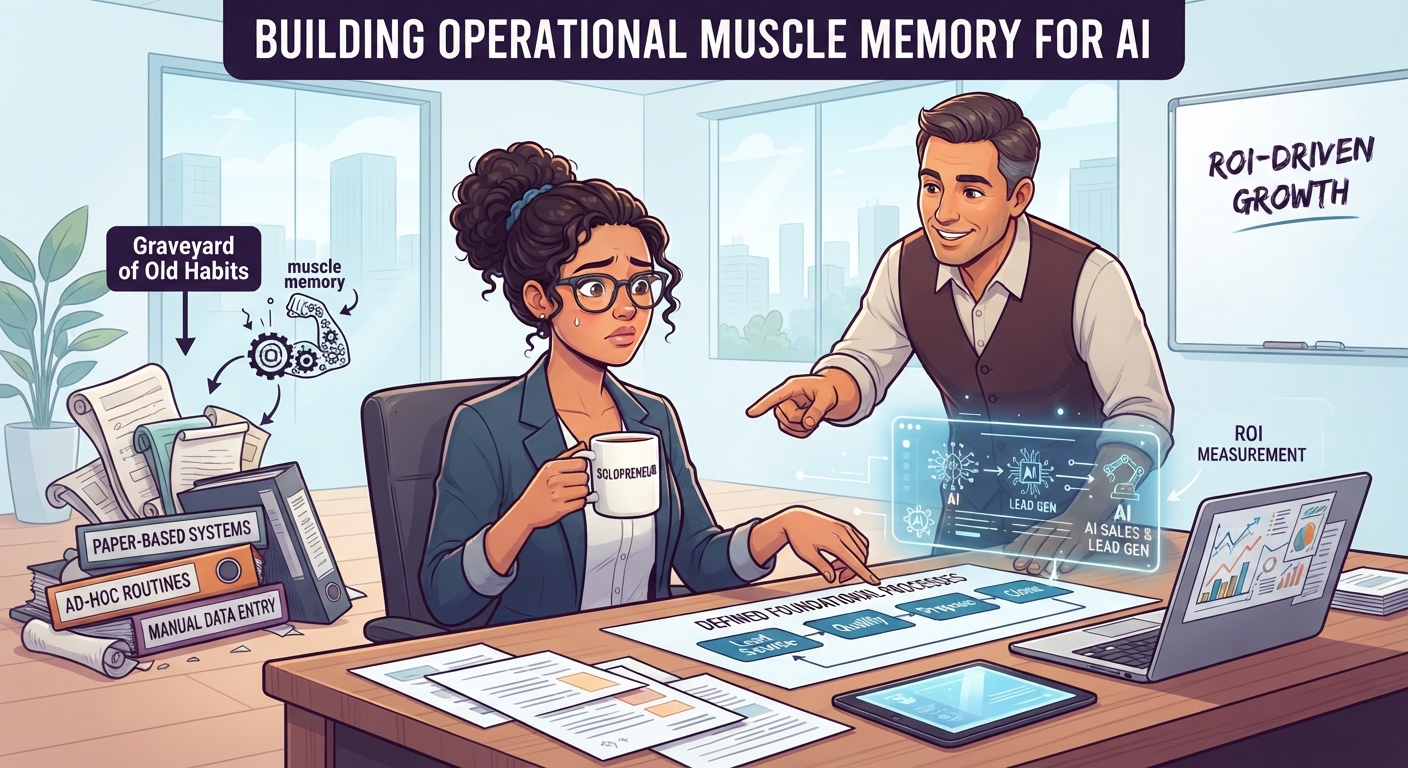
As a small business owner, solopreneur, or operations manager, your time is a finite resource. The thought of adding 'another technology' or 'new system' to an already packed schedule can feel overwhelming. I get it. You've built your business on established routines, and those patterns, whether they're documented or just 'how we do things,' are deeply ingrained. Changing them isn't just about learning a new tool; it's about retraining your entire operational muscle memory.
Having worked with countless businesses to integrate practical technology, I've seen firsthand how challenging it is to break free from what’s familiar, even when there's a clear path to improvement. It's normal to fall back into old habits, and it takes deliberate, systematic effort to embed new ways of working. That's why, when we talk about AI for sales and lead generation, my focus is always on protecting you from costly mistakes and ensuring every step forward delivers a measurable return. We'll start with the foundational clarity of your current processes, because you simply cannot automate what you haven't first clearly defined.
Today, we’re looking at leveraging AI to boost your sales and lead generation efforts, but always through the lens of practical, ROI-driven improvements that build on a solid operational foundation.
Readiness Check
Before diving into AI for sales, how well could a new team member pick up your current lead generation and sales outreach process without asking you questions?
They'd need a lot of hand-holding – it's mostly in my head or ad-hoc.
We have some steps written down, but it's not fully comprehensive or always followed.
It's clearly documented, regularly updated, and consistently followed by the team.
Solutions by Implementation Level
Level 1: AI-Powered Personalized Sales Communication (Starting with Claude)
Level: AI Literacy
This is about using AI to draft highly personalized emails, LinkedIn messages, or even initial qualification questions, significantly reducing the time spent on manual copywriting. Before you even think about automation, you need to understand what makes your current outreach successful and why. Claude (by Anthropic), our preferred LLM, excels at understanding context and generating nuanced, human-like text, making it ideal for crafting messages that resonate with prospects. This isn't about letting AI write and send; it's about AI as your highly efficient writing assistant.
Implementation Details:
Timeline: 2-4 hours to learn basic prompting and integrate into your daily writing flow.
Cost: Free tier for Claude.ai, or $20/month for Claude Pro for higher usage and advanced features.
ROI: Saves 5-10 hours/month on drafting personalized outreach messages. At $50/hour, this is $250-$500/month savings, easily 12x-25x ROI on the Pro plan.
Failure Rate: 10% if users don't review output or lack clear guidelines; 5% if guidelines are clear.
Action Steps:
Document your existing successful sales email templates and key messaging points.
Sign up for Claude (claude.ai) and explore its interface.
Experiment with prompts: 'Draft a personalized cold email for a CEO of a manufacturing company about [specific pain point] offering [your solution]. Include a compelling hook and a clear call to action.'
Refine prompts based on output quality. Always review and edit AI-generated content for your brand voice and accuracy before using.
Recommended Tools:
Claude (by Anthropic) - Free tier / $20/month for Pro
Protective Warning: Never copy-paste AI output directly without review. AI can hallucinate, misunderstand context, or sound generic. Your reputation is on the line. Use it as a powerful draft generator, not a fully autonomous writer. Over-reliance without review leads to impersonal, off-brand communication.
Level 2: Basic Lead Data Scraping & Enrichment
Level: AI Literacy
This involves using AI-powered tools to identify potential leads, gather publicly available contact information (like email addresses, phone numbers, LinkedIn profiles), and enrich existing lead data with additional firmographic or technographic details. It's about automating the tedious, manual research step of lead generation, allowing your sales team to focus on engagement. Crucially, your process documentation must define who a good lead is before these tools can help you find them effectively.
Implementation Details:
Timeline: 4-8 hours for setup and initial training; ongoing time for list refinement.
Cost: $49-$199/month, depending on lead volume and features (e.g., Seamless.AI, Apollo).
ROI: Saves 15-30 hours/month on manual lead research. At $50/hour, this is $750-$1500/month savings, a minimum 3x ROI even at higher costs.
Failure Rate: 20% if lead criteria aren't clear or data isn't regularly cleaned; 10% with clear process and data hygiene.
Action Steps:
Clearly define your ideal customer profile (ICP) – what industries, company sizes, roles, pain points are you targeting?
Choose a reputable lead enrichment tool like Seamless.AI or Apollo (see tools below).
Integrate the tool with your existing sales process for adding leads (even if manual for now).
Start with a small batch of leads, review the data quality, and refine your search parameters.
Recommended Tools:
Seamless.AI - Starts at ~$150/month (estimate)
Apollo.io - Free tier, paid plans from $49/month
Protective Warning: Be acutely aware of data privacy regulations (GDPR, CCPA, CAN-SPAM). Ensure the data you're collecting is compliant and used ethically. Don't assume quantity over quality; a large list of irrelevant leads is worse than a small list of highly qualified ones. Define your qualification criteria before you start scraping.
Level 3: Automated Lead-to-CRM Flow & Personalized Follow-up Triggers
Level: Integration
This solution takes the enriched lead data from Level 2 and automates its entry into your CRM, then triggers personalized follow-up sequences based on lead behavior or qualification status. This requires a well-defined CRM process and clear rules for lead handoff and nurturing. It's about ensuring no lead falls through the cracks and that your sales team engages at the right time with the right message, all based on your documented sales funnel stages.
Implementation Details:
Timeline: 10-20 hours for initial setup, integration, and workflow design; ongoing refinement.
Cost: $29-$99/month for an integration platform (e.g., Zapier, Make) plus existing CRM costs. Some lead enrichment tools offer direct CRM integrations.
ROI: Saves 20-40 hours/month on manual data entry and follow-up scheduling, plus improved conversion rates. At $50/hour, this is $1000-$2000/month savings, easily 10x ROI.
Failure Rate: 30% if CRM processes aren't standardized or if integration rules are poorly defined; 15% with clear processes and thorough testing.
Action Steps:
Ensure your CRM has a clean, standardized lead entry and qualification process documented.
Map out the exact 'if this, then that' logic for lead transfer and follow-up triggers.
Use an integration platform (like Zapier or Make) to connect your lead enrichment tool to your CRM.
Set up automated email or task sequences in your CRM based on lead status or behavior. Test thoroughly with dummy data before going live.
Recommended Tools:
Zapier - Free tier, paid plans from $29/month
Make (formerly Integromat) - Free tier, paid plans from $9/month
Protective Warning: The biggest risk here is 'garbage in, garbage out.' If your lead data is messy or your CRM processes are inconsistent, automation will only amplify the chaos. Over-automating follow-ups without human oversight can also lead to impersonal, poorly timed communication. Always include a human review point for critical steps.
Level 4: AI for Sales Call/Meeting Transcription & Insight Extraction
Level: Advanced
This involves using AI tools to transcribe sales calls or meetings, analyze the conversation for keywords, sentiment, talk-to-listen ratios, and identify key discussion points or action items. This moves beyond simple text generation to deeper analytical insights from spoken communication, helping sales teams refine their pitch, understand customer needs better, and improve training. It requires a mature sales process where insights can be consistently applied and acted upon.
Implementation Details:
Timeline: 20-40 hours for tool selection, setup, team training, and integration into review processes.
Cost: $50-$200/month per user for specialized tools (e.g., Dialpad, Gong, Chorus).
ROI: Improves sales team effectiveness by 10-20% through better coaching and understanding of customer needs. If a sales rep generates $10,000/month, a 10% improvement is $1,000/month, yielding a 5x-20x ROI per rep.
Failure Rate: 25% if insights aren't acted upon or if the team resists adoption; 10% with strong leadership buy-in and a clear action plan for insights.
Action Steps:
Ensure you have a clear process for recording and storing sales calls (with proper consent).
Evaluate AI call intelligence platforms like Dialpad that integrate with your communication channels.
Train your sales team on how to use the insights generated by the AI (e.g., identifying common objections, successful closing techniques).
Establish a routine for sales managers to review AI-generated summaries and coaching points with their team members.
Recommended Tools:
Dialpad - Starts at $15/user/month for basic AI features
Gong.io - Contact for pricing (enterprise-focused)
Protective Warning: Privacy and consent are paramount. Always inform participants if calls are being recorded and analyzed by AI. Avoid over-relying on AI's interpretation without human verification, especially for nuanced conversations. This tool is for insight and coaching, not for replacing human judgment or empathy in sales interactions. It also requires a cultural shift in how sales teams receive feedback.
Real-World Example
Type: smart-no-go
Business: A boutique B2B consulting firm (12 employees) specializing in HR strategy.
Situation: The firm relied heavily on referrals and manual LinkedIn outreach for lead generation, which was inconsistent. They heard about 'AI Lead Generation Agents' that promised to fully automate lead discovery, qualification, and initial outreach, and were excited by the prospect of scaling without hiring.
Approach: Before committing to a $5,000/year 'AI agent' platform, I advised them to first document their existing manual lead generation process. This involved detailing every step: how they identified ideal clients, what criteria they used for qualification, the exact messages they sent, and how they tracked responses. As they documented, they realized their process was highly intuitive, relied on subtle human judgment, and wasn't consistently followed by all consultants. The 'AI agent' tool, while powerful, required explicit, rule-based instructions that their current undefined process couldn't provide.
Result: They decided against the advanced AI agent. Instead, they spent two weeks refining and documenting their manual process into a clear, repeatable system. They then adopted Claude for drafting personalized outreach messages (Level 1) and a basic lead enrichment tool (like Apollo) to gather contact details for clearly defined ICPs (Level 2). This immediate, smaller investment cost them less than $200/month and allowed them to increase qualified leads by 30% in three months, saving them the $5,000 upfront cost and the frustration of a misaligned advanced tool.
Lesson: Don't fall for the allure of 'full automation' if your underlying process isn't clear and repeatable. Technology amplifies efficiency, but it cannot create a process where none exists. A 'smart no-go' on a complex solution can save significant time, money, and frustration, allowing you to build a stronger foundation first.
Systems Thinking Insight
Your business isn't just a collection of tasks; it's an interconnected system. Every step, every decision, every interaction forms part of a larger pattern. Over time, these patterns become deeply ingrained – in your team's muscle memory, in unspoken assumptions, and in the 'way we've always done it.' This is why introducing new technology, especially something as transformative as AI, feels so challenging. It’s not just about learning a new button; it’s about disrupting comfortable, long-established mental and operational pathways. Your brain, and your team's, will naturally want to revert to the old, familiar ways because they require less cognitive load.
This is precisely why documentation before automation isn't just a best practice; it's a non-negotiable prerequisite. You cannot effectively leverage AI to improve a sales process that exists only in someone's head. Without a clear, written map of your current journey – from initial lead discovery to closed deal – you'll automate chaos, not efficiency. Documentation forces you to confront inefficiencies, clarify ambiguities, and create the stable ground upon which technology can build. It's the critical step that respects the human element of change by making the 'new way' clear, repeatable, and less daunting.
Quick Wins
1. Document Your Top 5 Lead Qualification Questions
Write down the exact questions you use to qualify a lead and the criteria for a 'good' vs. 'bad' answer. This clarity is foundational for any AI lead scoring or outreach.
Time: 30 minutes
Cost: Free
Impact: Improved consistency in lead qualification, clearer instructions for future AI tools.
2. Use Claude to Brainstorm Cold Email Subject Lines
Give Claude (claude.ai) your target audience, your offer, and your desired outcome, then ask it to generate 10 compelling, non-spammy subject lines. Pick your favorite and test it.
Time: 15 minutes
Cost: Free (using Claude's free tier)
Impact: Potentially higher open rates on your outreach, saves creative thinking time.
3. Review Your CRM for Incomplete Lead Data
Spend 20 minutes looking at 10-20 recent leads in your CRM. Are all the fields filled in? Is the data consistent? Identifying gaps now highlights areas where AI enrichment could help later.
Time: 20 minutes
Cost: Free
Impact: Better data hygiene, clearer understanding of data needs for future automation.
Resource of the Day
Claude (by Anthropic) (Tool)
Our preferred AI assistant for generating text, summarizing information, brainstorming ideas, and even basic coding tasks (use claude.ai/code for dedicated coding assistance). It's an invaluable partner for drafting sales copy, refining messaging, and understanding complex information, all with a focus on safety and helpfulness. Start with the free tier to get a feel for its capabilities.
Cost: Free / $20/month for Pro
Link: Access Resource