Using AI for quality and compliance when you don't have documented processes
Using AI for quality and compliance when you don't have documented processes
Why leadership's AI enthusiasm hits a wall without current SOPs
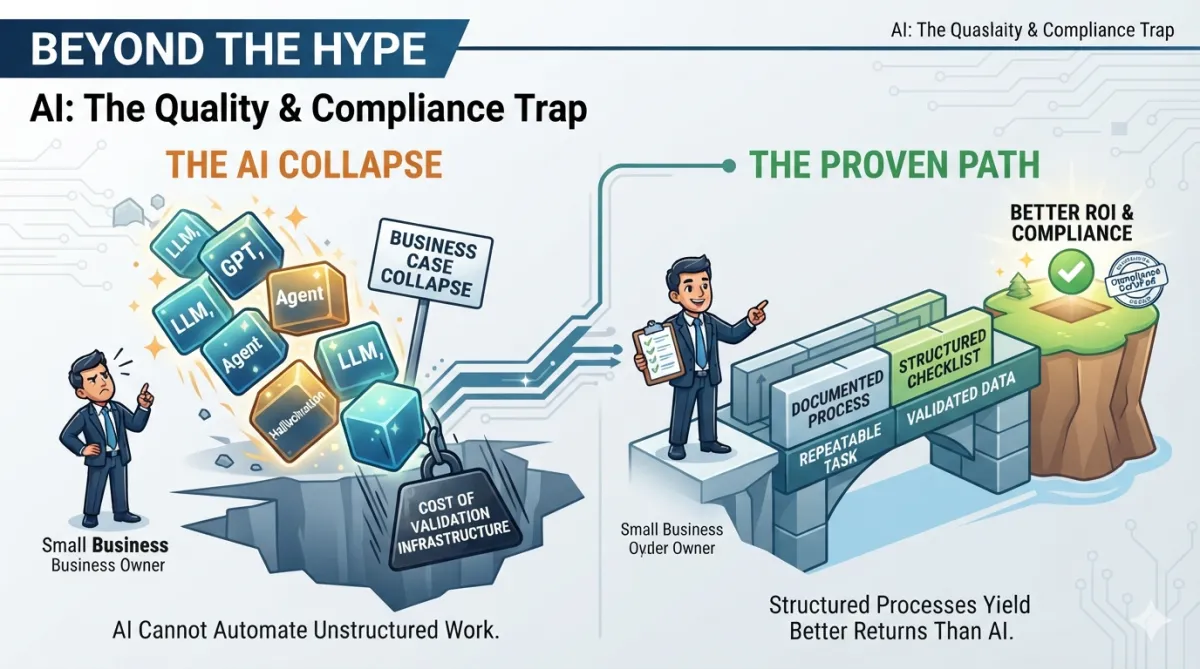
AI can't automate quality and compliance work that isn't documented, repeatable, and validated first. The business case collapses when you add the cost of building the validation infrastructure AI requires. Most small businesses get better returns by documenting processes and implementing structured checklists before considering AI.
Decision: prepare (confidence: 85%)
The decision to "prepare" rather than proceed comes down to a fundamental mismatch: AI systems for quality and compliance require comprehensive documentation, validation protocols, and audit trails that most small businesses don't have. Leadership sees the promise of automation, but the operational reality is that you can't automate what you can't explain, and you can't validate outputs against processes that exist only in experienced employees' judgment. The “prepare” recommendation acknowledges that AI might eventually make sense, but only after foundational work that delivers immediate value on its own.
The decision in front of the owner
Leadership wants to use AI for quality control or compliance monitoring. Maybe they saw a demonstration where AI caught defects in product images, or read about automated compliance document review. The pitch sounds straightforward: point the AI at your quality checks or regulatory requirements, let it learn the patterns, reduce errors and save time.
But that's not the decision in front of you. The real decision is whether to invest in the documentation, validation infrastructure, and human review protocols that AI requires before you can trust its output. Those requirements don't disappear just because the AI tool itself is affordable or easy to deploy. AI compliance means proving your organization governs, monitors, and controls every AI system, not just using AI to check other things.
Here's what you're actually deciding: Can you define, document, and validate every quality check and compliance task to the level of precision that AI systems demand? Can you build the human review process that catches AI errors before they create liability? Can you maintain audit trails that satisfy regulators who want to know how decisions were made? The AI tool is the easy part. The infrastructure to use it safely is the expensive part. And if that infrastructure doesn't exist today, you're deciding whether to build it first or keep doing what you're doing.
The gap between those two decisions explains why so many AI projects in quality and compliance stall after the pilot phase. The demo works. The vendor delivers the tool. Then reality hits: nobody can agree on what the AI should be checking, what accuracy rate is acceptable, or who's responsible when it's wrong. Too many teams spend six months integrating something they didn't need, only to discover they should have spent that time documenting the process they already had.
Why it looks attractive
The vendor demonstrations are compelling. AI spots defects human inspectors miss. It reads regulatory documents faster than your compliance team. It flags issues in real-time instead of during quarterly audits. The promise is clear: catch problems earlier, reduce errors, free up your quality and compliance staff for higher-value work.
The cost structure looks reasonable at first glance. Many AI tools for quality and compliance are priced per user or per transaction, not as massive enterprise deployments. You're not building a custom system from scratch. You're subscribing to a service that other companies already use. The vendor might even offer a free trial or pilot program to prove the value before you commit.
There's also legitimate pressure from the market. Your competitors might be exploring AI. Your customers might expect it. Regulatory bodies are starting to acknowledge AI-assisted compliance in their guidance documents. Doing nothing feels like falling behind, especially when leadership is asking why you're not taking advantage of tools that could reduce risk and improve quality.
The human factor matters too. Your quality and compliance staff are overloaded. They're doing repetitive checks that feel like they should be automatable. They're missing things because they're tired or rushed. AI promises to handle the routine work so they can focus on judgment calls and complex situations. That's an attractive proposition when you're trying to do more with the same headcount. The emotional appeal of AI isn't just about technology. It's about relief from unsustainable workloads and the constant worry that something will slip through.
What is commonly overlooked
The vendor demonstration shows AI catching defects or flagging compliance issues. What it doesn't show is the six months of work required before you can trust those outputs enough to act on them. Standard operating procedures must already exist and be current before AI can learn from them or validate against them. If your quality checks exist mostly in experienced employees' heads, or if your compliance procedures are outdated Word documents nobody follows, AI can't help you. It can only amplify whatever inconsistency you already have.
Human review requirements are consistently underestimated. Best practice is to use humans strategically, focusing on edge cases, low-confidence predictions, or periodic audits, but that assumes you know what an edge case looks like in your specific context. Early in deployment, everything is an edge case. Your subject matter experts need to review AI outputs extensively to establish baseline accuracy and identify systematic errors. That review work doesn't replace the manual process. It adds to it. You're running two systems in parallel until you're confident enough to reduce human oversight.
The validation infrastructure is the hidden cost that breaks most business cases. Any system influencing a release decision needs a documented validation path, and that path includes version control for AI models, accuracy audits on a defined schedule, change management procedures, and audit trails that satisfy regulators. Small businesses rarely have this infrastructure for their manual processes, let alone for AI systems. Building it requires dedicated staff time, specialized expertise, and ongoing maintenance that continues long after the AI tool is deployed.
Liability allocation is rarely discussed until something goes wrong. If AI approves a defective product or misses a compliance violation, who's responsible? Your insurance carrier might have specific requirements or exclusions for AI use. Your regulatory body might require human accountability for all decisions. Your vendor's terms of service probably limit their liability to the subscription cost, not the cost of a product recall or regulatory fine. These questions need answers before deployment, not after a failure.
What must be true for it to work
Your processes must be documented to a level of precision that most small businesses haven't achieved. That means written procedures for every quality check and compliance task, with clear decision criteria, acceptable tolerances, and escalation paths. The documentation must be current, not aspirational. It must reflect what actually happens, not what should happen according to a procedure written five years ago. If three different employees perform the same quality check three different ways, AI can't learn a consistent pattern. It will either pick one person's approach arbitrarily or create a hybrid that nobody recognizes.
AI readiness measures whether an organization has the right strategy, data, technology, and culture to adopt AI. For quality and compliance, that translates to specific operational requirements. You need subject matter experts who can validate AI outputs and explain why they're right or wrong. You need a quality management system mature enough to absorb validation requirements, audit trails, and change management procedures. You need data quality standards for inputs, whether those are product images, sensor readings, or compliance documents. Poor input quality guarantees poor output quality, regardless of how sophisticated the AI model is.
You need clear agreement on acceptable error rates before deployment, not after. What percentage of defects can AI miss before it creates unacceptable risk? What percentage of false positives can your team handle before the review burden negates any efficiency gain? These thresholds vary by industry, product, and regulatory environment. A 95% accuracy rate might be excellent for some applications and catastrophic for others. The business decision isn't whether AI is accurate in general. It's whether AI accuracy meets your specific requirements, and whether you can measure that accuracy reliably over time.
You need a budget for validation infrastructure that may exceed the cost of the AI tool itself. That includes staff time for ongoing review and recalibration, technical resources for integration with existing systems, legal review of liability and insurance implications, and potentially external consultants to establish validation protocols that satisfy regulatory requirements. If leadership is budgeting only for the AI subscription cost, the project will stall when these additional costs surface. The smallest companies often face the highest relative costs because they lack existing infrastructure to build on.
Hidden costs and operational requirements
The AI tool subscription might be $500 to $2,000 per month, depending on volume and features. That's the visible cost. The hidden costs start with process documentation. If you don't have current, detailed procedures for every quality check and compliance task, someone needs to create them. That's not a one-time project. It's an ongoing maintenance requirement as products change, regulations update, and processes evolve. For a small business, expect 40 to 80 hours of subject matter expert time just to document existing processes to a level where AI can work with them.
Human review during initial deployment is the largest hidden cost. Your quality or compliance lead needs to validate AI outputs extensively for the first 3 to 6 months. That might mean reviewing 100% of AI decisions initially, then gradually reducing to risk-based sampling as confidence builds. If your quality lead is already working at capacity, this review work either doesn't happen (creating risk) or requires hiring additional staff or contractors. Budget at least 10 to 20 hours per week of senior staff time during initial deployment, decreasing to 5 to 10 hours per week for ongoing monitoring once the system stabilizes.
Integration with existing systems is rarely plug-and-play. Your quality management system, document management system, and compliance tracking tools need to connect with the AI platform. That requires technical resources to build and maintain integrations, troubleshoot data quality issues, and handle version updates. Even if the vendor provides APIs, someone on your team needs to understand them and keep them working. For businesses without dedicated IT staff, this often means external consultants at $100 to $200 per hour for initial setup and periodic troubleshooting.
Validation infrastructure includes accuracy audits on a defined schedule, version control for AI models, change management procedures, and audit trails that satisfy regulatory requirements. Your AI compliance checklist should cover risk classification, human oversight, audit trails, operating guardrails, and bias and fairness testing. Building this infrastructure from scratch requires expertise most small businesses don't have in-house. External consultants or fractional compliance resources might cost $5,000 to $15,000 for initial setup, plus ongoing costs to maintain documentation and conduct periodic audits. These costs continue as long as you use the AI system, not just during initial deployment.
Risks and failure conditions
The most immediate risk is regulatory non-compliance due to undetected AI errors. If AI misses a compliance violation or approves something that violates regulatory requirements, you're still responsible. The regulator doesn't care that an AI made the mistake. They care that your organization failed to catch it. The consequences range from warning letters and fines to product recalls and loss of operating licenses, depending on your industry and the severity of the violation. For small businesses, a single significant compliance failure can be existential.
Liability exposure increases when AI handles quality decisions. If a defective product passes AI quality checks and causes customer harm, your legal exposure depends on whether you can demonstrate reasonable care in validating the AI system. Cross-border risks complicate liability frameworks, particularly in cases involving multinational corporations, but even domestic operations face questions about whether AI use constitutes due diligence or negligence. Your insurance carrier might have specific requirements for AI use, or might exclude AI-related claims from coverage. These questions need answers before deployment, not after an incident.
Model drift is the silent failure mode that catches businesses off guard. AI accuracy degrades over time as products change, regulations update, or input data quality shifts. Without systematic monitoring, you won't notice until accuracy has dropped significantly. By then, you might have weeks or months of questionable decisions to review. Preventing model drift requires ongoing validation, periodic retraining, and clear triggers for human review when accuracy metrics decline. That's an operational burden that continues indefinitely, not a one-time setup cost.
Over-reliance on AI leads to skill atrophy in your quality and compliance staff. If AI handles routine checks for months or years, your team loses the hands-on experience that builds judgment for complex situations. When AI fails or encounters an edge case, you need human experts who can step in confidently. If those experts have spent the last two years just reviewing AI outputs instead of doing the work themselves, their skills have degraded. This creates a dangerous dependency where you can't operate effectively with or without the AI system.
Data security and confidentiality breaches create risk that extends beyond your business. Quality and compliance data often includes proprietary product specifications, customer information, regulatory findings, and internal control weaknesses. If that data is exposed through a vendor breach or misconfigured AI system, the consequences include customer notification requirements, regulatory scrutiny, competitive disadvantage, and potential litigation. Small businesses rarely have the security infrastructure to protect data once it leaves their direct control, yet many AI platforms require uploading sensitive information to vendor-managed cloud systems.
Non-AI alternatives
Structured checklists and digital forms deliver immediate value without the complexity of AI. Take your existing quality checks and compliance tasks, document them precisely, and create digital checklists that employees follow step-by-step. This forces process documentation, creates audit trails, and reduces variability in how work gets done. The implementation cost is low (many form builders cost $20 to $50 per month), the training requirement is minimal, and the risk is negligible. You get immediate benefits even if you later decide to add AI on top of these structured processes.
Workflow automation for compliance documentation routing and approvals handles a significant pain point without requiring AI. Many compliance tasks involve getting the right information to the right people at the right time, then tracking who reviewed what and when. Traditional workflow tools can automate routing, send reminders, enforce approval sequences, and maintain audit trails. This addresses the administrative burden of compliance without the validation requirements and error risks of AI interpretation. For small businesses, workflow automation often delivers better ROI than AI because it solves the coordination problem, not the judgment problem.
Statistical process control with automated alerts on traditional metrics works for many quality applications. Instead of teaching AI to recognize defects, track key metrics (dimensions, weights, test results, cycle times) and set automated alerts when they drift outside acceptable ranges. This catches systematic problems early without requiring AI to make judgment calls about individual items. The approach is well-understood, widely accepted by regulators, and supported by affordable software. It requires discipline to collect data consistently, but that discipline is valuable regardless of what technology you use.
Investing in better training and certification for your existing quality and compliance team might deliver better returns than automating their work. If quality issues stem from inconsistent application of standards or lack of expertise, adding AI doesn't fix the root cause. It just adds another layer of complexity. Targeted training, industry certifications, and mentorship programs build capability that improves all aspects of quality and compliance work, not just the tasks you automate. The investment in people pays dividends across situations AI can't handle.
Hiring additional quality staff or using contract inspectors is the straightforward alternative that businesses often dismiss too quickly. If you need more quality checks or compliance monitoring, hiring someone to do that work delivers predictable results with known costs and no validation complexity. The cost might be higher than AI in steady state, but the implementation risk is lower and the accountability is clearer. For small businesses with seasonal demand or project-based quality needs, contract inspectors provide flexibility without long-term commitments. Sometimes the boring solution is the right solution.
Measurement requirements
Start by measuring what you have now, before any AI consideration. What percentage of quality checks and compliance tasks have written procedures that a new employee could follow without asking questions? What's your current defect rate, compliance violation rate, or audit finding rate? How much time do quality and compliance staff spend on routine checks versus judgment calls and complex situations? These baseline metrics tell you whether you have a documentation problem, a capacity problem, or an accuracy problem. They also establish the comparison point for evaluating whether AI delivers value.
Process consistency is the metric that predicts AI success or failure. Have three different employees perform the same quality check independently and document their steps. If their documented processes match closely, you have consistency that AI can learn from. If they diverge significantly, you have a process definition problem that AI will amplify rather than solve. Measure consistency across all tasks you're considering for AI automation. Any task with low consistency needs process documentation work before AI makes sense.
During initial deployment, measure AI accuracy against human expert judgment, not against the AI's own confidence scores. Have your subject matter experts review a statistically significant sample of AI outputs (at least 100 decisions per month initially) and classify them as correct, incorrect, or uncertain. Track accuracy by decision type, input quality, and time period to identify systematic errors or drift. Set clear thresholds for acceptable accuracy (typically 95% or higher for quality and compliance applications) and stop deployment if accuracy falls below those thresholds for two consecutive measurement periods.
Measure human review time and cost throughout deployment. The business case for AI assumes reduced human effort, but that reduction should be measured, not assumed. Track how many hours per week your team spends reviewing AI outputs, investigating errors, and handling escalations. Compare that to the baseline time for manual processes. If review time isn't decreasing as AI accuracy improves, something is wrong with the implementation or the task isn't suited for AI automation.
Measure validation infrastructure costs separately from AI tool costs. Track staff time for ongoing monitoring, technical resources for integration and maintenance, external consultant costs for validation protocols, and any insurance premium changes related to AI use. These costs should stabilize and decrease over time as the system matures. If they remain high or increase, the business case is deteriorating and you need to reassess whether to continue. The goal isn't to prove AI works. The goal is to understand whether it works well enough to justify the total cost of using it safely.
Recommended decision
Prepare. Don't proceed with AI deployment for quality and compliance until you've documented your current processes, established baseline metrics, and built the validation infrastructure AI requires. That preparation work delivers immediate value regardless of whether you eventually deploy AI. It also reveals whether your quality and compliance challenges are actually automation problems or process definition problems.
The “prepare” recommendation comes from a straightforward cost-benefit analysis. Most small businesses lack the documented processes, validation infrastructure, and human review capacity that AI systems require. Building that infrastructure costs more than the AI tool itself and takes longer than leadership expects. But here's the key insight: that infrastructure is valuable on its own. Documented processes reduce errors and training time. Structured checklists create audit trails and consistency. Baseline metrics identify improvement opportunities. Validation protocols satisfy regulatory requirements. You need these things whether you use AI or not.
Start with process documentation. Pick your three most critical quality checks or compliance tasks. Have your subject matter experts document every step, decision criterion, and escalation path. Test the documentation by having someone unfamiliar with the task follow it without asking questions. Revise until it works. This exercise takes 20 to 40 hours per task, but it surfaces the inconsistencies and judgment calls that would cause AI to fail. More importantly, it gives you documented procedures you can use for training, audit responses, and continuous improvement.
Implement structured checklists and digital forms for the tasks you just documented. This creates the consistency and audit trails AI requires, but with technology you can deploy in days instead of months. Measure the impact on error rates, training time, and staff workload. If structured checklists solve the problem, you're done. If they help but don't fully address capacity or accuracy concerns, you've built the foundation AI needs to succeed.
Revisit the AI decision in 6 to 12 months, after you've established baseline metrics, documented key processes, and implemented structured checklists. At that point, you'll have real data about where AI might add value and where traditional automation or process improvement delivers better returns. You'll also have the validation infrastructure and human review capacity AI requires. The decision will be clearer because you'll understand your actual needs, not just vendor promises. Most businesses that follow this path discover they don't need AI after all. The process documentation and structured checklists solved the underlying problems at a fraction of the cost and complexity.
Practical next step
Pick one quality check or compliance task that leadership thinks AI should handle. Have three different employees perform that task independently this week and document every step they take. Don't tell them you're comparing their approaches. Just ask each person to write down their process as if training someone new.
Compare the three documented processes. If they match closely, you have a task that's well-defined and potentially suitable for automation (AI or otherwise). If they diverge significantly, you've identified the real problem: the process isn't consistent enough to automate. The variation exists in people's heads, and AI can't learn from that.
Schedule a 90-minute working session with those three employees and your quality or compliance lead. Review the documented processes together. Identify where they differ and why. Agree on a single standard process that combines the best elements of each approach. Document that standard process in detail, including decision criteria, acceptable tolerances, and when to escalate.
That's your next step. It costs nothing except staff time you'd spend anyway. It reveals whether you have an automation opportunity or a process definition problem. And it produces a documented procedure you can use immediately for training, quality control, and audit responses. If you can't complete this exercise successfully for one task, you're not ready for AI. If you can complete it, you've built the foundation everything else requires.
Alternatives
AI option: Deploy AI for quality inspection or compliance monitoring, with the understanding that this requires comprehensive process documentation, extensive human review during initial deployment, validation infrastructure for ongoing monitoring, and clear liability allocation. Expect 6-12 months before AI accuracy is reliable enough to reduce human oversight significantly. Total cost including validation infrastructure will likely be 2-3x the AI tool subscription cost.
Traditional automation: Implement workflow automation for compliance documentation routing and approvals, combined with statistical process control for quality metrics. Use rule-based automated alerts for known trigger conditions. This addresses coordination and monitoring challenges without requiring AI judgment or extensive validation. Implementation time is typically 4-8 weeks with lower risk and clearer ROI.
Process improvement: Document existing quality and compliance processes using structured checklists and digital forms. Implement lean or Six Sigma methodologies to reduce defects at source rather than catching them downstream. This forces process consistency, creates audit trails, and often reveals that capacity problems are actually process definition problems. Delivers immediate value at low cost.
Software configuration: Deploy quality management system (QMS) software or compliance management platforms that provide structured workflows, audit trails, and reporting without AI interpretation. These systems enforce consistency through forms and checklists rather than learning patterns. They're well-understood by regulators and supported by mature vendor ecosystems. Cost ranges from $50-$500/month depending on features and user count.
Human-led: Hire additional quality staff or contract inspectors to increase capacity. Invest in training and certification for existing teams to improve expertise and consistency. This delivers predictable results with clear accountability and no validation complexity. Particularly effective for seasonal demand or project-based quality needs where flexibility matters more than automation.
Recommended: Start with process improvement: document key processes using structured checklists and digital forms. This builds the foundation AI requires while delivering immediate value. If checklists solve the problem, stop there. If they help but don't fully address capacity or accuracy concerns, you've built the foundation to evaluate AI or traditional automation with real data about where they might add value.