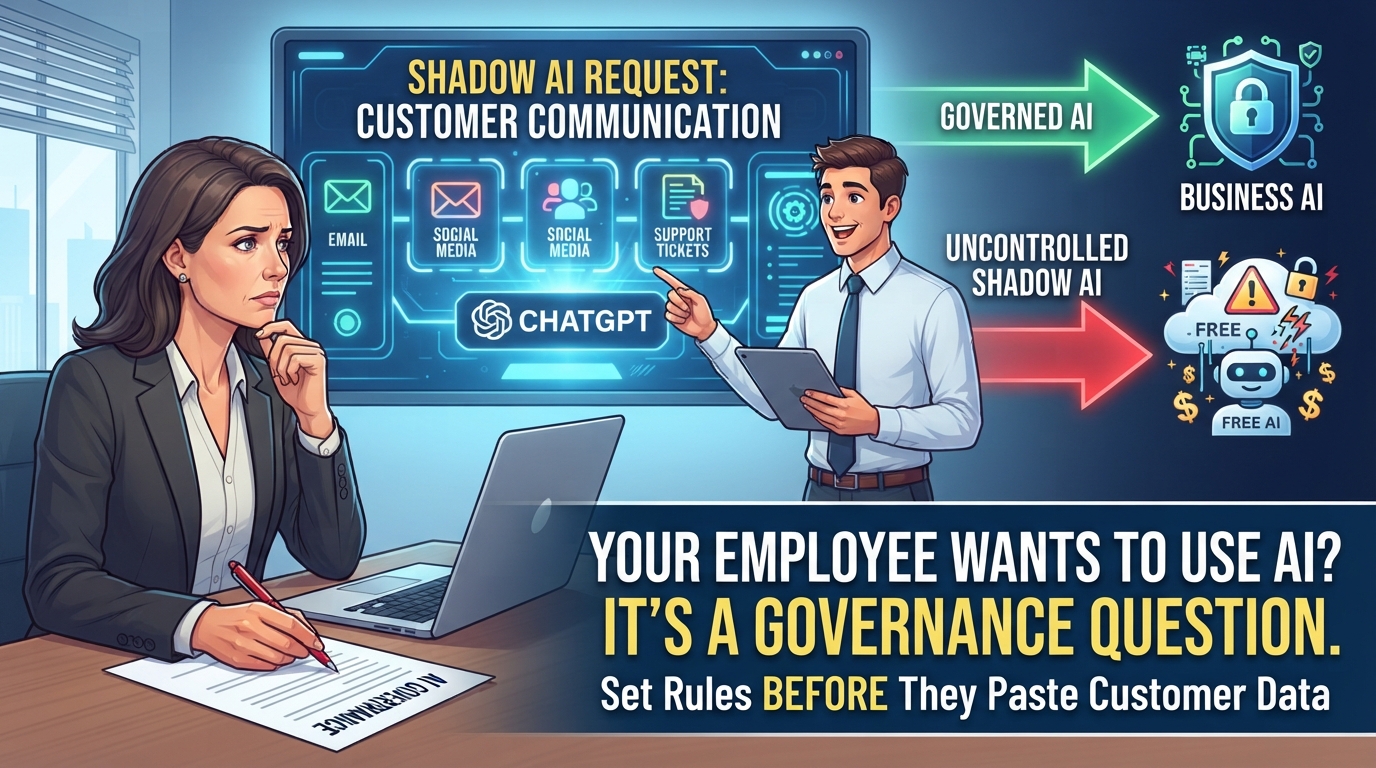
Your employee wants to automate customer communication with AI
Your employee wants to automate customer communication with AI
What to do when shadow AI is already happening in your business
The decision in front of the owner
An employee asked if they can use AI for customer emails, social media responses, or support tickets. That's not a technology question, it's a governance question. Can you set and enforce minimum operating rules before someone pastes customer data into ChatGPT?
The employee asking permission is actually good news. You've got a brief window to set boundaries before shadow AI use spreads across your team. Once three people are using free consumer AI tools to process business data, you've lost control of where your customer information lives. A single unauthorized session can create privacy violations, compliance problems, and data exposure you won't discover until it's too late.
You're choosing between three paths: approve a business-grade AI tool with real oversight, implement simpler automation that doesn't need AI governance, or admit you can't manage AI safely right now and stick with what you can control. Most owners think this is binary. Do you allow AI or ban it. It's not. The real choice is about governance capacity.
The timeline matters more than the technology. If you can't implement basic rules, training, and review processes within 30 days, you're better off with traditional automation. The employee's request creates urgency, but urgency shouldn't override your actual capacity to manage the tool. Saying yes without governance is worse than saying no.
Why it looks attractive
The appeal is obvious and legitimate. Customer communication takes time. Your team answers the same questions repeatedly. An AI tool can draft responses in seconds instead of minutes. For a small team handling 50-100 customer emails per day, saving even 2 minutes per email adds up to real capacity.
The employee asking permission has probably already tried it. They've seen it work. They pasted a customer question into ChatGPT, got a decent draft, edited it slightly, and sent it. The customer was happy. The employee saved time. Nothing broke. From their perspective, this is a no-brainer efficiency gain.
And they're not entirely wrong. AI can handle routine communication reasonably well. Standard thank-you messages, appointment confirmations, basic product questions, shipping updates. These aren't creative writing exercises. They're structured communication that follows patterns. AI is decent at patterns. The employee sees an opportunity to spend less time on repetitive work and more time on complex customer issues. That's a reasonable business case, assuming you can control the risks they're not thinking about.
What is commonly overlooked
Most small business owners evaluate AI tools based on the vendor demo: the interface looks simple, the output seems reasonable, and the price is affordable. What they don't see is the governance infrastructure required to use AI safely for customer communication.
First, you need someone to review AI-generated content daily for the first 60 days. Not skim it—actually read it for accuracy, tone, and potential commitments. I've watched this play out with a 12-person professional services firm where the owner assumed spot-checking meant reading one email per week. Two months in, they discovered the AI had been promising delivery timelines they couldn't meet because no one was actually reviewing the output consistently.
Second, you need clear escalation procedures for situations the AI shouldn't handle. Complaints, refund requests, complex technical questions, and anything involving legal or financial commitments should go to humans. But employees need to know what triggers escalation, and they need to follow the procedure even when they're busy. Without this clarity, the AI becomes a liability rather than an efficiency tool.
Third, unauthorized AI use creates legal exposure when business data is processed through platforms without proper data handling agreements. Consumer AI tools typically don't provide the data processing agreements, audit trails, or data residency controls that business use requires. The risk isn't theoretical—it's contractual and regulatory.
Fourth, you must address customer disclosure requirements. Some jurisdictions and industries require disclosure when AI is used in customer communication, particularly in legal, healthcare, and financial services contexts. Legal work product created with AI assistance may require disclosure to clients and opposing counsel. Even outside regulated industries, customers increasingly expect to know when they're interacting with AI rather than humans. You need a clear policy on when and how to disclose AI use, and you need employees to follow it consistently.
Fifth, the approved AI tool will change its terms of service, pricing, or data handling practices during your contract period. You need someone monitoring vendor communications and evaluating whether changes affect your risk profile. Most small businesses don't discover vendor policy changes until they're already in effect.
The governance overhead isn't a one-time setup cost. It's ongoing operational work that someone must own, monitor, and maintain. For a 3-10 person business without dedicated IT or compliance staff, this overhead often exceeds the time savings the AI provides.
What must be true for it to work
For AI-assisted customer communication to work safely in a small business, several conditions must be true. These aren't aspirational goals, they're minimum requirements.
You need someone with capacity to review AI output daily for 60 days. Not skim it during lunch. They have to actually read it with attention to accuracy, tone, and potential commitments. This person needs authority to pause AI use if problems emerge, and they need protected time that won't get displaced by other urgent work. If you don't have this capacity, the governance fails regardless of how good the AI tool is.
You need employees who will follow IT policies consistently. If your team has a history of using unapproved tools, sharing passwords, or bypassing security procedures, adding AI to the mix increases risk rather than reducing it. AI governance requires discipline, and you can't build discipline through policy documents alone.
You need clarity on customer disclosure requirements for your industry and jurisdiction. If you're in healthcare, finance, or legal services, AI use in customer communication may trigger specific disclosure or consent requirements. Even outside regulated industries, you need a policy on whether and how to inform customers that AI is involved in their communication. This isn't optional - it's an operational requirement that must be defined before the first AI-generated email goes out.
You need a business-grade AI tool with a data processing agreement, not a free consumer platform. The tool must specify where data is processed, how it's stored, who has access, and under what conditions it's retained or deleted. Consumer AI platforms typically don't provide these guarantees, which means using them for customer data creates compliance exposure.
You need defined use cases and clear boundaries. Which types of communication are appropriate for AI assistance? Which must remain fully human? What triggers escalation to a supervisor? Employees need specific guidance, not general principles. "Use good judgment" isn't sufficient when the technology is new and the risks are unclear.
You need baseline measurements of current performance. Without knowing how long customer communication currently takes, what your error rate is, and what your customer satisfaction scores are, you cannot determine whether AI provides actual improvement or just feels more efficient. Measurement discipline must exist before implementation, not after.
Finally, you need realistic expectations about time savings. AI doesn't eliminate work, it shifts work from drafting to reviewing and correcting. If you're expecting 80% time savings, you'll be disappointed. If you're expecting 20-40 seconds per routine email after accounting for review overhead, you might achieve that. The business case depends on honest projections, not vendor promises.
Hidden costs and operational requirements
The tool subscription is the smallest cost. A business AI platform might run $20-50 per user per month. That's visible. What's not visible is the time cost of implementation and ongoing oversight.
Week one requires 8-12 hours of someone's time to inventory current AI usage, select an approved tool, document basic use cases, and communicate the policy to the team. That's probably the owner's time, which has opportunity cost. Week two requires another 4-6 hours to set up the approved tool, integrate it with your existing systems if needed, and train employees on the specific use cases you've approved.
Ongoing, you're looking at 30-60 minutes per day for human review during the first 60 days. That's 20-40 hours over two months. After the initial period, you still need spot-checking. Budget 15 minutes per day indefinitely. That's 5 hours per month of supervisory time that wasn't required when humans wrote all the emails.
Then there's the policy maintenance cost. AI tools change their features and terms of service frequently. You need someone monitoring whether your approved tool is still appropriate, whether new features create new risks, and whether employee usage is staying within approved boundaries. That's another 2-3 hours per quarter. It doesn't sound like much until you realize it's a new recurring task that never existed before.
If you're serious about governance, you also need basic logging. Who used AI for what communication, when, and did a human review it before sending? You need this for two reasons: accountability if something goes wrong, and measurement to know if this is actually saving time. Setting up even simple logging takes 3-5 hours initially and requires someone to review the logs monthly. Another 1-2 hours per month.
Add it up. You're looking at 15-20 hours of implementation work, 20-40 hours of intensive oversight in the first 60 days, then 8-10 hours per month ongoing. For a small business, that's real capacity. If your team is already running at 100% utilization, where does this time come from?
Risks and failure conditions
The highest-probability risk is gradual quality degradation that you don't notice until customers start complaining. AI-generated communication sounds professional. It's grammatically correct. It's polite. But it slowly drifts away from your actual policies and brand voice. By the time you notice, you've sent hundreds of emails that don't quite match your standards. This happens when human review gets inconsistent or when reviewers start trusting the AI too much and stop reading carefully.
The highest-severity risk is data exposure. If customer data ends up in an unapproved AI platform's training data, you may have violated your privacy policy, industry regulations, or contractual commitments. Depending on your industry and location, this could trigger mandatory breach notification, regulatory fines, or loss of customer trust. The probability is hard to estimate because you don't know what employees have already done, but the impact is significant enough that you can't ignore it.
The third risk is AI hallucination creating business commitments you can't keep. The AI might tell a customer they can return a product after your actual return window. It might promise a discount you don't offer. It might commit to a delivery date you can't meet. When this happens, you have three bad options: honor the commitment and lose money, refuse the commitment and lose the customer's trust, or blame the AI and look incompetent. This is not hypothetical. The customer doesn't care that AI made the mistake. They care that your business made a promise.
The fourth risk is employee resistance or workarounds. If your approved process is slower or more restrictive than the unapproved tools employees were already using, they'll find ways around it. They'll use the unapproved tools on personal devices. They'll use the approved tool for logging but do the actual work elsewhere. They'll comply technically but not practically. This is a failure condition because it means you're paying for governance theater while the actual risk continues.
According to guidance on AI incident response planning, you need a formal process to recognize, contain, and manage AI incidents. For a small business, this doesn't mean a 40-page document. It means knowing what to do if you discover customer data in an unapproved platform, if a customer complains about AI-generated communication, or if an employee bypasses your approved process. If you don't have answers to these scenarios before you approve AI use, you're not ready.
Non-AI alternatives
Before you accept the overhead of AI governance, consider whether traditional automation solves the same problem with less risk. Email templates and text expansion tools can handle 60-70% of routine customer communication without any AI. A well-organized template library with 15-20 standard responses covers most common scenarios. Text expansion tools let employees type a short code and automatically insert a full paragraph. No data leaves your systems. No review overhead. No governance complexity.
For example, if most customer emails are appointment confirmations, shipping updates, or answers to five common product questions, you don't need AI. You need better templates and a macro tool. The time savings is nearly identical. An employee types "ship1" and gets a complete shipping update paragraph with merge fields for tracking numbers and delivery dates. That takes 10 seconds instead of 2 minutes. AI would take 15 seconds and require review. The template is faster and safer.
The second alternative is structured workflow automation in your CRM or help desk system. Many customer communication scenarios follow predictable patterns. Order placed triggers confirmation email. Three days with no shipping triggers follow-up. Customer rates experience below 3 stars triggers manager review. These workflows can generate or suggest communication without AI. The logic is rule-based, which means it's predictable, auditable, and doesn't hallucinate.
If the real problem is that employees don't know how to handle certain customer situations, the solution might be training and documentation, not AI. A decision tree that walks employees through common scenarios. A knowledge base with approved language for different situations. Regular coaching on tone and brand voice. This builds capability in your team instead of outsourcing judgment to a tool they don't understand.
The alternative that actually addresses the shadow AI problem is acknowledging that employees want help with repetitive work and giving them approved tools that don't require AI. If you implement good templates, text expansion, and workflow automation, the employee who asked about AI might find they don't need it anymore. And if they still want AI after you've provided solid alternatives, that tells you something about whether the AI request is about efficiency or about using a tool they find interesting.
Here's the test: if you implement templates and text expansion and the employee still pushes for AI, they might have a legitimate use case for the small percentage of communication that doesn't fit patterns. If they stop asking, the AI request was really about reducing repetitive work, and you've solved it more simply.
Measurement requirements
You need baseline measurements before you approve any AI use. How many customer communications does your team send per day? How long does it take to write a typical email? What's your current customer satisfaction score or response quality level? Without baseline data, you can't measure whether AI actually helps or just feels helpful.
The primary metric is time saved per communication, measured honestly. Not "AI can generate a draft in 10 seconds" but "AI generates a draft in 10 seconds, employee reviews and edits for 45 seconds, supervisor spot-checks for 15 seconds, total time 70 seconds versus 90 seconds to write from scratch." The real time savings might be 20 seconds per email, not 80 seconds. That's still valuable if you're sending 100 emails per day, but it's a different ROI calculation than the vendor's demo suggested.
The secondary metric is quality maintenance. Track customer satisfaction scores, complaint rates, and any communication that requires correction or follow-up. If AI-assisted communication generates more follow-up questions or corrections than human-written communication, it's not actually saving time. It's shifting the time to a different part of the workflow. You need to measure the full cycle, not just the drafting step.
The third metric is compliance with approved usage. How many times per week do you detect unapproved AI tool usage? This requires some form of monitoring, whether that's network traffic analysis, random device checks, or employee self-reporting. If compliance is below 80% after 30 days, your governance approach isn't working and you need to either simplify the approved process or increase enforcement.
The fourth metric is error rate. How many AI-generated communications contain factual errors, policy violations, or tone problems that human review catches? Track this weekly for the first 60 days. If the error rate isn't declining, either the AI tool isn't learning your context or employees aren't providing good input. Either way, the tool isn't becoming more reliable over time, which means the review overhead won't decrease.
You also need to track the overhead cost. How much time per week goes into reviewing AI-generated communication, updating policies, investigating potential violations, and managing the approved tool? If this overhead exceeds the time saved, you're losing money. This is the metric that most small businesses don't track until it's obvious that governance is consuming more resources than the AI is returning.
Recommended decision
Conditional proceed, but not for the reason the employee expects. You're not approving AI because it's a good idea. You're approving it because refusing it doesn't stop the risk. The employee who asked permission isn't the problem. The five employees who didn't ask are the problem. Your choice is between controlled AI use with visibility and rules, or uncontrolled AI use that continues in the shadows.
The conditions are non-negotiable. You must establish visibility into current AI usage within two weeks. You must select one approved tool and clearly communicate which use cases are allowed. You must implement daily human review for 60 days. You must create a simple escalation process for questionable AI output. And you must be willing to block unapproved tools if employees don't comply.
If you can't meet these conditions within 30 days, defer instead. Block all AI tools at the network level, implement better templates and text expansion tools, and revisit AI in six months when you have capacity to govern it properly. Ungoverned AI use is worse than no AI use.
The confidence level is 72% because this decision depends heavily on your specific team culture and current shadow AI exposure. If you have a team that follows processes and communicates honestly, the conditions are achievable. If you have a team that routinely bypasses IT policies or doesn't take data security seriously, governance will fail and you should avoid AI entirely.
This isn't a decision about whether AI is good at writing emails. It's a decision about whether you can implement minimum controls faster than the risk of data exposure or compliance violation. For most small businesses with 10-30 employees, the answer is yes, but only if you start immediately and treat this as a risk management exercise, not an innovation project.
Practical next step
Send an email to everyone who communicates with customers. The subject line: "Quick question about AI tools." The body: "We're updating our policies on AI tools for customer communication. Please reply with a list of any AI tools you've tried or used in the past 90 days for drafting emails, responses, or other customer communication. This includes ChatGPT, Claude, Gemini, or any other AI writing assistant. No penalty for disclosure. We need to know what's already in use so we can provide approved options that work better."
Give them 48 hours to respond. If you don't get responses from at least 80% of your customer-facing team, you have a trust problem that needs to be addressed before you can implement AI governance. In that case, your next step is a conversation about why employees don't feel safe being honest about tool usage.
Once you have the disclosure data, spend two hours documenting your three most common customer communication scenarios. Not every scenario. Just the top three that consume the most time. For each scenario, write down the current process, the typical time required, and any business rules or policies that must be followed. This becomes your baseline for evaluating whether AI actually helps.
Then make a decision within one week. Either select an approved AI tool and implement the conditions outlined in this brief, or block AI tools and implement better templates and text expansion instead. The worst outcome is letting this sit for three months while employees continue using unapproved tools and you continue having no visibility into where your customer data is going.
If you choose to proceed with approved AI, your first 30 days look like this: Week 1, select tool and communicate policy. Week 2, train the team and implement a review process. Weeks 3-4, review every AI-generated communication and track time savings, error rates, and compliance. At day 30, you make a second decision: continue with adjusted parameters, increase enforcement, or shut it down. You're not committing to AI forever. You're committing to a 30-day experiment with clear measurement and an exit plan.