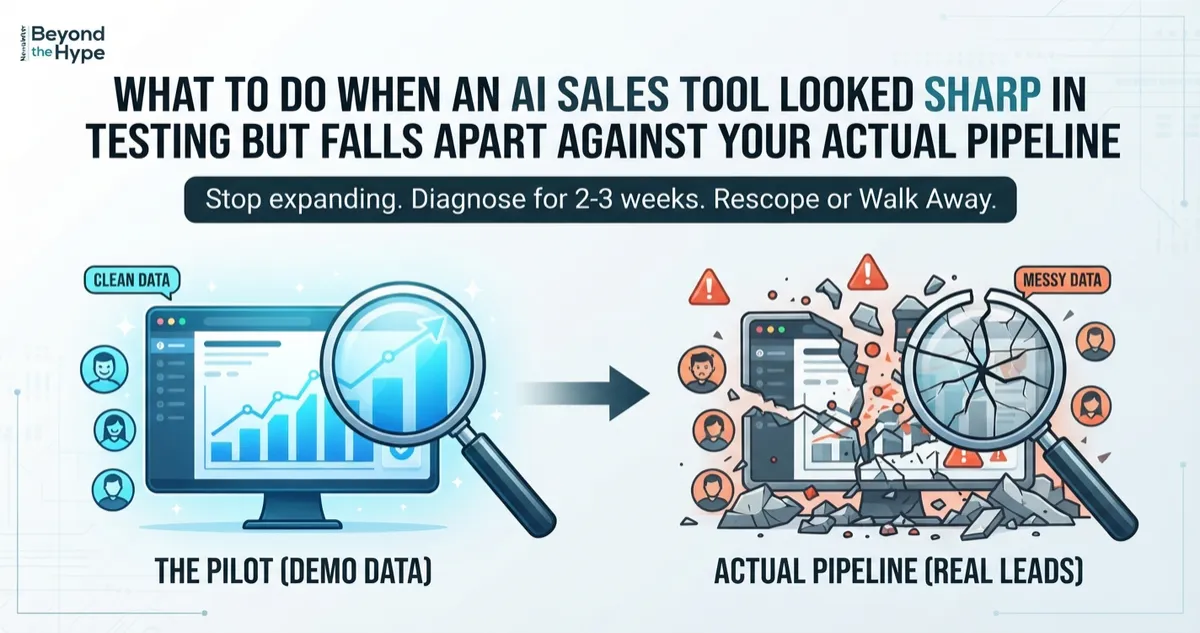
The lead scoring pilot worked in the demo.
The lead scoring pilot worked in the demo. Now it's guessing on real leads.
What to do when an AI sales tool looked sharp in testing but falls apart against your actual pipeline
A pilot that worked with clean demo data and breaks on your real leads is not a configuration problem you patch your way out of. It's usually a sign the process, data, and ownership weren't ready for automation in the first place. Stop expanding it, diagnose the real cause over two to three weeks, and decide from there whether to rescope it small or walk away.
Decision: defer (confidence: 72%)
The pattern here matches a well-documented failure mode: pilots degrade gradually as real-world variety hits them, not all at once, which makes the problem easy to miss and easy to explain away as a tuning issue (Tungsten Automation, 2026). Before spending another dollar on the vendor relationship, you need to know whether the failure is data quality, missing human judgment at key steps, or a CRM process that was never standardized to begin with. Each of those has a different fix, and none of them are solved by just using the tool more.
The decision in front of the owner
You ran a pilot. It looked good in the demo, maybe even good in the first two or three weeks of real use. Then it started getting things wrong: scoring dead leads as hot, sending outreach that didn't match the actual conversation history, or missing obvious signals your team would have caught in five seconds. Now you're deciding whether to keep pushing, rescope it smaller, or pull the plug.
This isn't really a question about whether AI works for sales. It's a question about whether this specific workflow, with your specific data and your specific team, is ready to be automated at all. Those are different questions, and conflating them is how a lot of small businesses end up six months deep in a tool nobody trusts.
The decision in front of you is narrow and practical: stop new investment until you know the root cause, or keep going and hope it resolves itself. Hope is not a plan. Why CRM Projects Fail and How to Overcome Them makes the point that most CRM and sales tooling failures trace back to something more fundamental than the software itself. That's worth sitting with before you sign another renewal.
Why it looks attractive
The demo worked. That's the whole appeal, and it's a powerful one. Someone on the sales team, or you, saw the tool score leads accurately, draft solid outreach, or flag the right accounts, and it felt like real time saved. Vendors lean into this hard: claims that the tool works out-of-the-box, that results in the demo reflect typical outcomes, and that it will keep improving automatically as it sees more of your data.
There's also a sunk cost pull. You've already paid for the license, maybe trained a few reps, maybe integrated it partway into your CRM. Walking away feels like admitting the investment was wasted, so the instinct is to keep tweaking settings and hope the next configuration change fixes it.
And traditional, rules-based lead scoring genuinely does have real limits. Why Traditional Lead Scoring Falls Short lays out why static scoring rules struggle to capture actual buying behavior, which is a fair critique. The problem is that fair critique of the old method doesn't automatically mean the new tool is ready for your business. Those are two separate claims, and the second one needs its own evidence.
What is commonly overlooked
Demos run on curated data. Your real pipeline doesn't. Your AI Pilot Worked. So Why Is It Failing at Scale? makes a point that applies directly here: AI tools rarely fail with one dramatic outage. They degrade quietly as the variety of real inputs grows, which is exactly the gap between a clean demo dataset and the messy, inconsistent lead records most small businesses actually have.
The second overlooked piece is ownership. A pilot that ran fine for the vendor's sales engineer during setup needs someone on your side watching it every week once it's live: checking outputs, catching drift, and retraining expectations across the sales team. The 4 Mistakes That Kill AI Pilots Before Production points to unmodeled data and missing feedback loops as recurring causes, not model quality. If nobody owns that feedback loop internally, the tool doesn't get better. It just gets ignored or quietly worked around.
The third gap, and the one I see most often with small teams, is adoption. Why CRM Adoption Fails at the Sales Rep Level names poor perceived value, manual data entry burden, and weak training as the real drivers of rep disengagement, not the software's feature list. If your reps were shown the tool once and told to use it, that's not training. That's a demo with extra steps.
What must be true for it to work
Clean, structured, and sufficiently large data has to exist before automation can do anything useful with it. If your CRM has duplicate records, inconsistent stage definitions, or half-filled fields depending on which rep entered the lead, no scoring model, AI or otherwise, is going to produce reliable output. This is the single most common reason pilots look great on sample data and fall apart on your actual pipeline.
Second, the process has to be standardized before the tool sits on top of it. If three reps qualify leads three different ways, the automation is learning from inconsistency and will produce inconsistent results back. How to Stop Scope Creep touches on a related theme for service businesses: systems only hold up when the underlying process is defined first, not bolted on after the fact.
Third, you need a named internal owner, not a committee and not "whoever has time." Someone has to watch the output weekly, flag drift, and have the authority to pause the tool if it's producing bad results. And fourth, sales staff need real training on the redesigned workflow, including what to do when the tool gets it wrong. If those four things aren't true yet, no amount of additional licensing spend fixes the pilot.
Hidden costs and operational requirements
The license fee is the smallest number in this decision. The real cost is staff time: hours spent manually checking the tool's output, patching bad scores before they reach a prospect, and re-explaining to reps why the automation said something that doesn't match what they know about the account. The Hidden Iceberg: The Real Costs of Scaling an SMB frames this well for small businesses generally: the costs that sink a project are rarely the ones in the contract. They're the operational drag that builds up below the surface.
There's also integration cost that doesn't show up until you're past the sandbox. Testing in a demo environment against sample data tells you almost nothing about how the tool behaves once it's pulling from your live CRM, with your messy fields and your actual lead volume. That integration testing against real tools, not demo conditions, is work someone has to do and budget for.
And there's a cost that's easy to miss: staff trust. If reps watch the tool get things wrong two or three times with real prospects, they stop using it, and getting that trust back later costs more than building it correctly the first time would have. That's not a line item anywhere, but it's real.
Risks and failure conditions
If the pilot continues unchanged, the most immediate risk is compounding errors reaching real prospects: a wrong score or mismatched outreach message doesn't just waste internal time, it can damage a relationship with someone who was a genuine buyer. That cost is hard to quantify precisely, but it isn't zero, and it should factor into any decision to keep the tool running without tighter human review.
There's also a data handling question worth confirming rather than assuming: check what customer or prospect data the vendor stored during testing, where it lives, and whether it's covered under your existing data handling terms. This is a verification step, not a confirmed exposure — but it belongs on the same checklist as the technical and process diagnostics before any further investment, since it's cheap to check now and expensive to discover later.
Non-AI alternatives
Several non-AI paths are available and worth evaluating on equal footing with continuing the pilot.
Rule-based CRM scoring (company size, engagement count, deal stage) sacrifices some nuance but gives full transparency into why a lead was scored a certain way, and it's usually cheap to stand up using tools already in the CRM.
Process standardization — documenting what your best reps already do informally and training the whole team to that standard — addresses the root issue if the real problem is inconsistent qualification criteria rather than a tooling gap. No tool, AI or otherwise, fixes a process that was never standardized in the first place.
Non-AI workflow automation (scheduled sequences triggered by explicit actions like a form fill or meeting booked) keeps a human deciding next steps at each branch point rather than a model inferring intent.
A human-led option — an experienced rep or dedicated qualifier manually scoring and routing leads — is slower per lead but far more predictable, and for teams under a few hundred leads a month, it's often cheaper than the staff time currently spent patching a failing pilot
Outsourced appointment-setting or lead-gen services are also worth a look if the core problem is capacity rather than scoring logic: a third-party service handles initial qualification and hands over only leads that meet agreed criteria. This shifts cost from a monthly license plus internal review time to a per-lead or retainer fee, and it can be a reasonable bridge while internal process and data are cleaned up — but it introduces its own vendor-dependency risk and works best as a temporary measure, not a permanent substitute for fixing the underlying CRM and qualification process.
As a rough illustration: if a part-time qualifier costs roughly $1,500–2,500/month and handles the current lead volume, compare that directly to the pilot's license cost plus the hours per week currently spent reviewing and correcting its output. If the pilot's all-in cost (license plus review time, valued at a reasonable hourly rate) exceeds that number, the manual or outsourced option is very likely cheaper right now, independent of whether the AI tool eventually works.
Measurement requirements
Before scaling or rescoping, track a minimum data set over the diagnostic window: accuracy of automated scores against experienced rep judgment on at least 50 real leads, manual review time per lead, actual usage logs (not self-reported adoption), and customer-facing errors per 100 leads processed.
Also confirm contract terms before deciding how urgent this is. If the license is month-to-month, deferring costs little beyond the diagnostic window. If it's an annual commitment already paid, that sunk cost shouldn't drive the decision to continue, but it does change the near-term cash calculus and is worth noting explicitly when presenting this to anyone else involved.
Pilots frequently fail to scale for structural reasons — data quality, process gaps, or unclear ownership — rather than simple misconfiguration (Why AI Pilots Fail at Scale). Treat any vendor-proposed fix as a hypothesis to test against your own sample, not a conclusion to accept.
Recommended decision
Defer. Not avoid, not full speed ahead. Pause new spending and new rollout until you've run the 50-lead accuracy check and identified whether this is a data problem, a process problem, or a genuine tool limitation. Each of those has a different fix, and guessing which one it is wastes more money than the two or three weeks it takes to find out.
The pilot's failure pattern, working on demo data and degrading on real leads, matches a known and common cause: unmodeled real-world variety hitting a system that was only validated on curated samples (Your AI Pilot Worked. So Why Is It Failing at Scale?). That's fixable in some cases and fatal in others, and you won't know which without doing the diagnostic work first.
If the diagnostic shows a clean data and process problem that you can fix in a few weeks, rescope small and retest before expanding again. If it shows the tool genuinely can't handle your lead volume or variety even with clean data, that's your answer too, and it's a cheaper one to accept now than after another quarter of patching.
Practical next step
Here's the part nobody wants to do first. Pull 25 to 30 real leads the pilot has already scored or touched, and have your most experienced rep walk through them manually, noting every place where the automation's judgment diverged from theirs. Write down why it diverged in each case: missing data, wrong assumption, or something the rule or model simply can't see.
This takes a day or two, not a committee, and it gives you the evidence to make the defer-or-rescope call with facts instead of vendor reassurance. Don't schedule another vendor call until you've done this. The vendor's instinct will be to call it a configuration issue, and maybe it is, but you won't know until you've looked at your own data honestly.
Once you have that list, decide with your team: rescope to a narrower, cleaner use case, or stop and go back to manual qualification with better documentation. Either is a reasonable outcome. What's not reasonable is spending another month tweaking settings on a tool nobody has actually diagnosed.
Alternatives
AI option: Continue developing the AI lead scoring or outreach pilot, but only after a diagnostic confirms the failure is a fixable data or process issue rather than a structural limitation of the tool against your real lead volume and variety.
Traditional automation: Replace the AI model with simple rule-based CRM workflows for lead scoring, such as scoring based on explicit fields like company size, engagement count, or deal stage. This sacrifices some nuance but gives you full transparency into why a lead was scored the way it was.
Process improvement: Document the lead qualification criteria your best reps already use informally, standardize it across the team, and train everyone to the same standard before any tool, AI or otherwise, sits on top of it.
Software configuration: Use non-AI email and CRM automation, such as scheduled follow-up sequences triggered by explicit actions (form fill, reply, meeting booked), with a human deciding next steps at each branch point rather than a model inferring intent.
Human-led: Have an experienced rep or dedicated qualifier manually score and route leads, especially if monthly volume is under a few hundred. This is slower per lead but far more predictable, and for many small teams it's cheaper than the staff time currently spent patching a failing pilot.
Recommended: Standardize the CRM process and qualification criteria first, paired with simple rule-based scoring as an interim step. Revisit AI once the data and process are clean enough that a real accuracy test is meaningful rather than noise.
ROI Analysis
Baseline needed: You need a pre-pilot baseline of lead qualification accuracy and time spent per lead under the manual process, so the pilot's performance can be compared against something real rather than against the vendor's demo numbers.
Direct costs: License or subscription fees paid to date, plus any setup or integration fees charged separately from the core subscription.
Implementation costs: Hours spent by internal staff configuring the tool, mapping it to CRM fields, and testing it against sandbox or early live data, which is often underestimated going in.
Training costs: Time spent training sales reps on the new workflow, not just the software interface, including any lost selling time during the training period.
Review costs: Ongoing hours each week spent by whoever is checking the tool's output for accuracy and correcting mistakes before they reach a prospect.
Adoption assumptions: The ROI case assumes sales reps will actually use the tool's output as intended. If reps route around it because they don't trust it, as described in Why CRM Adoption Fails at the Sales Rep Level, the projected time savings never materialize.
Capacity impact: If the tool fails often enough that reps double-check every output, it adds review work rather than removing it, which reverses the intended capacity gain.
Measurement period: Run the 50-lead accuracy test immediately, then reassess after 30 days of corrected process (if rescoped) before making a longer-term commitment.
Governance
Approved use: Define explicitly which lead scoring or outreach decisions the tool is allowed to make unsupervised versus which ones require a human sign-off before reaching a prospect.
Data access: Confirm what customer or prospect data the vendor has stored during the pilot, where it's stored, and whether it's covered under your existing data handling terms. Treat this as a verification step to complete during the diagnostic window, not a confirmed problem — but confirm it before any further investment rather than after.
Human review: Every automated score or outreach action needs a human checkpoint before it reaches a live prospect until the tool has demonstrated consistent accuracy over at least 90 days on real data.
Escalation: Define who a sales rep contacts when the tool produces an obviously wrong result, and make sure that person has the authority to pause or override the automation, not just log a support ticket with the vendor.
Accountability: One named internal owner, not a shared responsibility, should be accountable for reviewing tool output weekly and reporting accuracy and adoption metrics to leadership monthly.
Sources
Why AI Pilots Fail to Scale: How to Turn AI Experiments Into ...
Why Traditional Lead Scoring Falls Short (And How AI Can ...)
How to Stop Scope Creep: 20 Years of Service Business Lessons