When the forecast was right but the data connection was wrong
When the forecast was right but the data connection was wrong
An e-commerce company connected inventory data to an AI vendor before checking what else went along with it
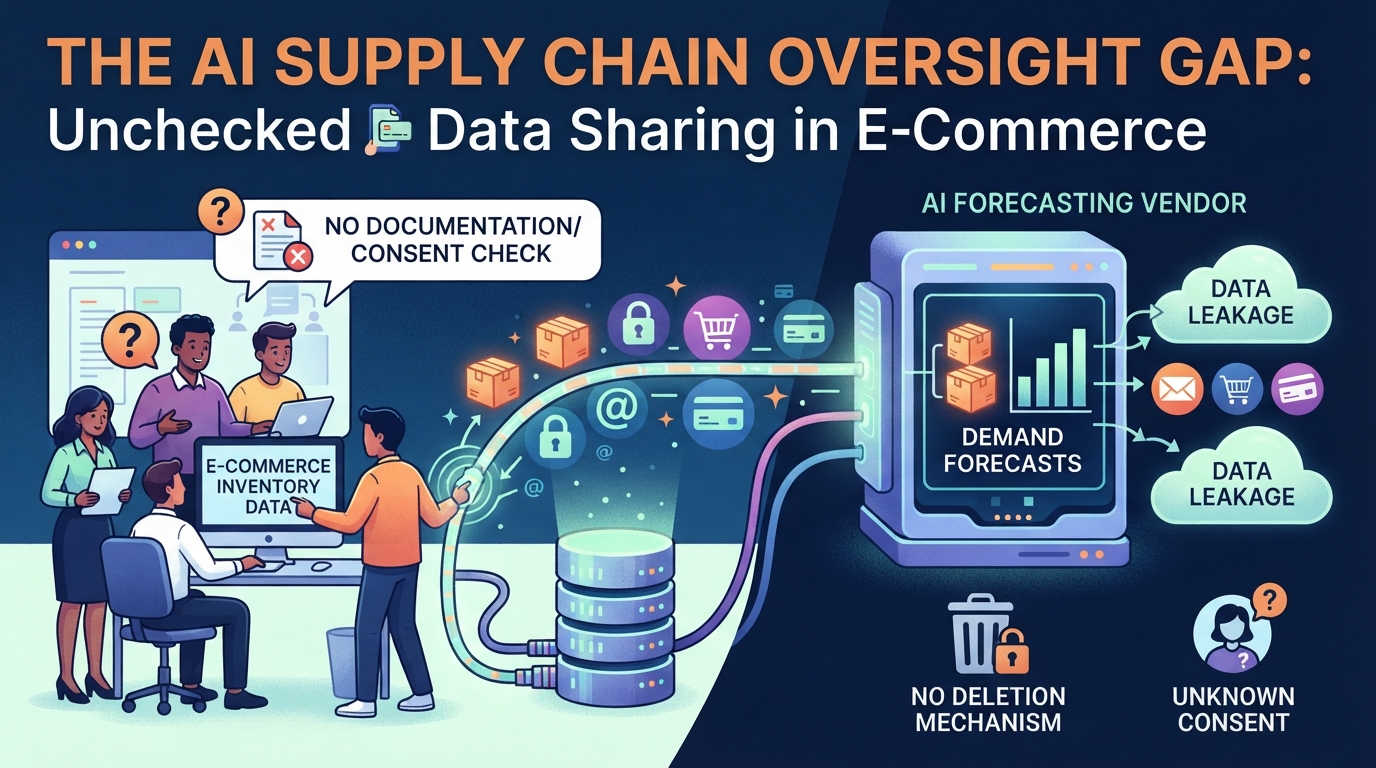
A 22-person online retailer gave an AI forecasting vendor database access to test demand predictions. The vendor received customer email addresses, purchase histories, and payment details that weren't needed for inventory forecasting. The pilot produced useful forecasts, but the company had no documentation of what data left their systems, no way to request deletion, and no record of whether customer consent covered AI processing.
Decision: prepare (confidence: 85%)
Most small businesses lack the data inventory, access controls, and vendor agreements needed to safely connect AI tools. Preparation work to document data flows, establish minimum access, and update vendor terms typically costs less than recovering from a data exposure incident or regulatory inquiry.
What happened
A 22-person online retailer selling home goods began exploring AI-powered demand forecasting to reduce stockouts during seasonal peaks. The vendor's sales process moved quickly. The integration process was straightforward—a connection to the company's e-commerce platform that typically takes minimal time to activate. The vendor's dashboard appeared within two weeks.
The forecasts looked reasonable. The AI correctly predicted increased demand for outdoor products in spring and suggested earlier ordering for holiday items. The operations manager began using the recommendations to adjust purchase orders.
Three weeks into the pilot, the company's bookkeeper noticed the contract while organizing files. She asked what customer data the vendor was accessing. The operations manager didn't know—the integration had requested database access, and he'd approved it to start the trial.
A closer look revealed the vendor was receiving customer email addresses, full purchase histories including product details and amounts, and payment method types. None of this information was necessary for inventory forecasting, which only requires aggregate sales quantities by product and date. The company had no documentation of what data had been transmitted, no technical controls limiting the vendor to necessary fields, and no process for requesting data deletion from the vendor's systems.
The contract included standard language about data processing but didn't specify retention periods or provide deletion mechanisms. The vendor's privacy policy mentioned sharing data with "service providers and partners" without defining who those entities were. The company had no record of whether their customer privacy policy's consent language covered sending purchase histories to AI vendors for forecasting purposes.
What appeared to be the problem
The apparent problem was a need for better inventory forecasting. The company experienced seasonal stockouts that frustrated customers and resulted in lost sales. They also carried too much inventory of certain products, tying up cash and eventually requiring markdowns.
The vendor's demonstration showed AI could analyze sales patterns and predict demand more accurately than the spreadsheet method the operations manager used. The pre-built integration promised to eliminate manual data export and import work. The vendor's security certifications and references from other small e-commerce companies suggested the tool was safe and appropriate.
From leadership's perspective, this looked like a straightforward pilot: connect the system, evaluate the forecasts, measure the results, and decide whether to continue. The technical setup was simple and the vendor handled the complexity.
What the actual problem was
The actual problem was the absence of data governance before connecting external systems. The company had no inventory of what data existed in their e-commerce platform, no documented sensitivity levels, and no process for evaluating what a vendor should access.
Pre-built integrations often request broad permissions because vendors design them to work across many use cases. The integration accessed customer personal information that wasn't necessary for inventory forecasting. AI demand forecasting requires at least 24 months of SKU-level sales history, current inventory positions, and related data, but customer email addresses and shipping details add no forecasting value.
The vendor agreement included standard terms that many small businesses accept without revision. Vendor agreements should include clear terms about how AI manages company data, but this contract specified only general data processing rights. The company had no leverage to request data deletion or restrict usage because they had already granted access.
The business also lacked clarity on regulatory obligations. GDPR compliance requires showing customers that their personal data is handled appropriately, and depending on where customers were located, the company might have notification or consent requirements before AI processing. The privacy policy's generic third-party language might not satisfy those obligations.
The overlooked condition
The overlooked condition was technical access control. The company assumed the integration would access only what the AI needed, but they had no method to verify or limit that access.
AI-ready data infrastructure requires a governed catalog, verified lineage, and business context before models go live. Small businesses rarely have formal data catalogs, but the principle applies: you must know what data you have, understand where it goes, and control who can access it.
The vendor's pre-built integration requested database-level access rather than field-level permissions. This is common because it simplifies the vendor's development work, but it means the vendor can access any data in connected tables. The company had no technical controls to restrict access to sales quantities, product IDs, and dates while blocking customer personal information.
Without access controls, the company depended entirely on vendor promises about what data they would use. AI agents can access personal data, modify accounts, and perform other sensitive actions, creating risks that extend beyond data exposure to operational errors. Even well-intentioned vendors may change their data usage practices, experience breaches, or share data with sub-processors the original company never approved.
What should have happened first
The company should have documented their data inventory before evaluating any AI vendor. This means listing the systems that would connect to AI tools, identifying what data fields exist in those systems, and categorizing which fields contain sensitive information.
For an e-commerce demand forecasting pilot, the necessary data includes product SKUs, sales quantities, dates, inventory levels, and possibly cost information. Customer names, contact details, and payment information are not required. A proper data inventory would have revealed this distinction and allowed the company to negotiate a more limited integration.
The next step should have been reviewing vendor terms before signing. An AI governance checklist includes an AI policy, tool inventory, user guidelines, data protection impact assessments for tools handling personal data, incident handling, and staff training. Small businesses don't need enterprise-level governance programs, but they do need someone to read vendor agreements and ask specific questions: What data will you access? How long will you retain it? Who are your sub-processors? What happens if we end the relationship?
The company should have established role-based access controls limiting who could approve integrations. In this case, the operations manager activated the connection without consulting anyone about data implications. A simple approval process requiring the owner or another designated person to review data access requests would have created an opportunity to catch the problem.
Finally, the company needed a test environment or limited pilot scope. Rather than connecting the entire production database, they could have exported a sanitized dataset with customer information removed, or limited the pilot to a single product category with manual data transfer. This would have allowed them to evaluate forecast quality without exposing unnecessary data.
How to prevent repetition
Create a data inventory template that lists each system, the data it contains, and sensitivity levels. This doesn't require sophisticated software. A spreadsheet with columns for system name, data fields, whether fields contain personal information, and business purpose is sufficient. Update this inventory whenever you consider connecting a new tool.
Establish a written approval process for any integration that accesses company data. The process should require the person requesting the integration to document what data will be accessed, why it's necessary, and what vendor terms govern its use. The business owner or a designated manager should review and approve before activation.
Develop a vendor questionnaire that asks specific data questions: What fields will you access? Can access be limited to specific fields? How long do you retain data? What are your deletion procedures? Who are your sub-processors? What certifications or audits verify your security practices? Send this questionnaire before signing any agreement.
Negotiate data minimization into vendor contracts. Many vendors will accommodate limited access if you ask before signing. Request contract language that specifies exactly what data the vendor can access, prohibits use for purposes other than the agreed service, and establishes retention limits and deletion procedures.
Review customer-facing policies before implementing AI that processes personal information. Your privacy policy should accurately describe what you do with customer data. If you plan to use AI for forecasting, recommendations, or other automated decisions, verify that your current policy covers this or update it accordingly. Depending on your customer locations and the type of processing, you may need explicit consent.
Implement logging for data access. Many e-commerce platforms and databases can log when external systems access data and what they retrieve. Enable these logs and review them periodically to verify vendors access only what you authorized.
Establish a regular vendor review schedule. At least annually, review what vendors have data access, whether that access is still necessary, and whether vendor terms have changed. Remove access for vendors you no longer use.
Recommended decision
Prepare before proceeding with AI pilots that require data connections.
The preparation work is not complex, but it is necessary. A small business can complete a basic data inventory, establish an approval process, and develop a vendor questionnaire in a few days of part-time work. This preparation costs far less than managing a data exposure incident, responding to regulatory inquiries, or losing customer trust.
The specific preparation steps are:
Document what data exists in systems you plan to connect to AI tools. Identify which fields contain customer personal information, competitive intelligence, or other sensitive content.
Designate one person accountable for approving data connections. This person should understand both the business need and the data implications.
Create a standard vendor questionnaire and require written answers before any integration. Focus on data access scope, retention, deletion, and sub-processor disclosure.
Review your customer privacy policy and terms of service. Verify they accurately describe your data practices and cover AI processing if applicable.
For your first AI pilot, use the smallest data scope that allows meaningful testing. Export a sanitized dataset, limit the pilot to one product category, or implement technical controls that restrict vendor access to necessary fields only.
Establish baseline metrics before the pilot begins so you can measure actual business impact, not just AI output quality.
Once these preparation steps are complete, you can evaluate AI vendors with appropriate caution. The goal is not to avoid AI entirely, but to ensure data connections happen with visibility, control, and accountability. Many AI tools can deliver value for small e-commerce businesses, but that value should not come at the cost of uncontrolled data exposure.
Alternatives
AI option: AI demand forecasting that analyzes historical sales patterns, seasonality, and trends to predict future inventory needs, typically requiring vendor access to sales and inventory data
Traditional automation: Rule-based reorder point systems that trigger purchase orders when inventory falls below defined thresholds, with seasonal adjustments set manually based on historical patterns. This requires no external data access and can be implemented in most inventory management software or even spreadsheets.
Process improvement: Structured monthly inventory review meetings where staff analyze sales reports, identify trends, and adjust order quantities collaboratively. This improves forecast accuracy through human judgment and institutional knowledge without technology investment.
Software configuration: Business intelligence dashboards that visualize sales trends, inventory turnover, and stockout frequency, allowing staff to make informed ordering decisions. Many e-commerce platforms include basic reporting that serves this purpose.
Human-led: Closer collaboration with key suppliers who may offer demand planning support, consignment arrangements, or shorter lead times that reduce the need for accurate long-term forecasting.
Recommended: Start with rule-based reorder points and structured review meetings. If forecast accuracy remains inadequate after improving these processes, then consider AI with appropriate data controls.
ROI Analysis
Baseline needed: Current stockout frequency and revenue impact, overstock carrying costs, staff time spent on manual forecasting, and existing forecast accuracy measured as mean absolute percentage error
Direct costs: Vendor subscription fees for AI forecasting tools (pricing varies widely by transaction volume and features; specific market pricing not available in evidence reviewed)
Implementation costs: Technical setup time (4-16 hours), data preparation and cleaning, vendor onboarding, and integration testing
Training costs: Staff training on interpreting AI forecasts, adjusting recommendations, and handling exceptions (8-16 hours initially, ongoing as needed)
Review costs: Ongoing validation of AI outputs before placing orders (2-4 hours weekly), data quality monitoring, and periodic vendor oversight
Adoption assumptions: Assumes staff will trust and act on AI recommendations, vendors will maintain service quality, and data quality will remain sufficient for accurate predictions
Capacity impact: May reduce time spent on manual forecasting (2-8 hours weekly) but requires new time for output validation and error correction
Measurement period: Minimum 6 months to account for seasonal variation, preferably 12 months for full annual cycle
Governance
Approved use: Written policy specifying that AI tools requiring data access must be approved by the business owner or designated manager before activation, with documentation of what data will be accessed and why
Data access: Customer personal information, purchase histories, payment details, supplier pricing, and profit margins should not be accessible to AI vendors unless specifically required for the approved use case
Human review: Manual review of AI forecast outputs before placing orders, with documented decision criteria for when to override AI recommendations. Staff must be able to identify and reject obviously wrong predictions.
Escalation: Clear process for reporting AI errors, data access concerns, or vendor issues to the person accountable for the tool, with defined response timeframes
Accountability: Single designated person (typically owner or operations manager) responsible for vendor relationships, data access approvals, and AI tool performance