Your AI documentation pilot stalled. Don't scale it yet.
Your AI documentation pilot stalled. Don't scale it yet.
A decision brief for small businesses deciding whether to push forward, fix, or walk away from an AI process documentation pilot
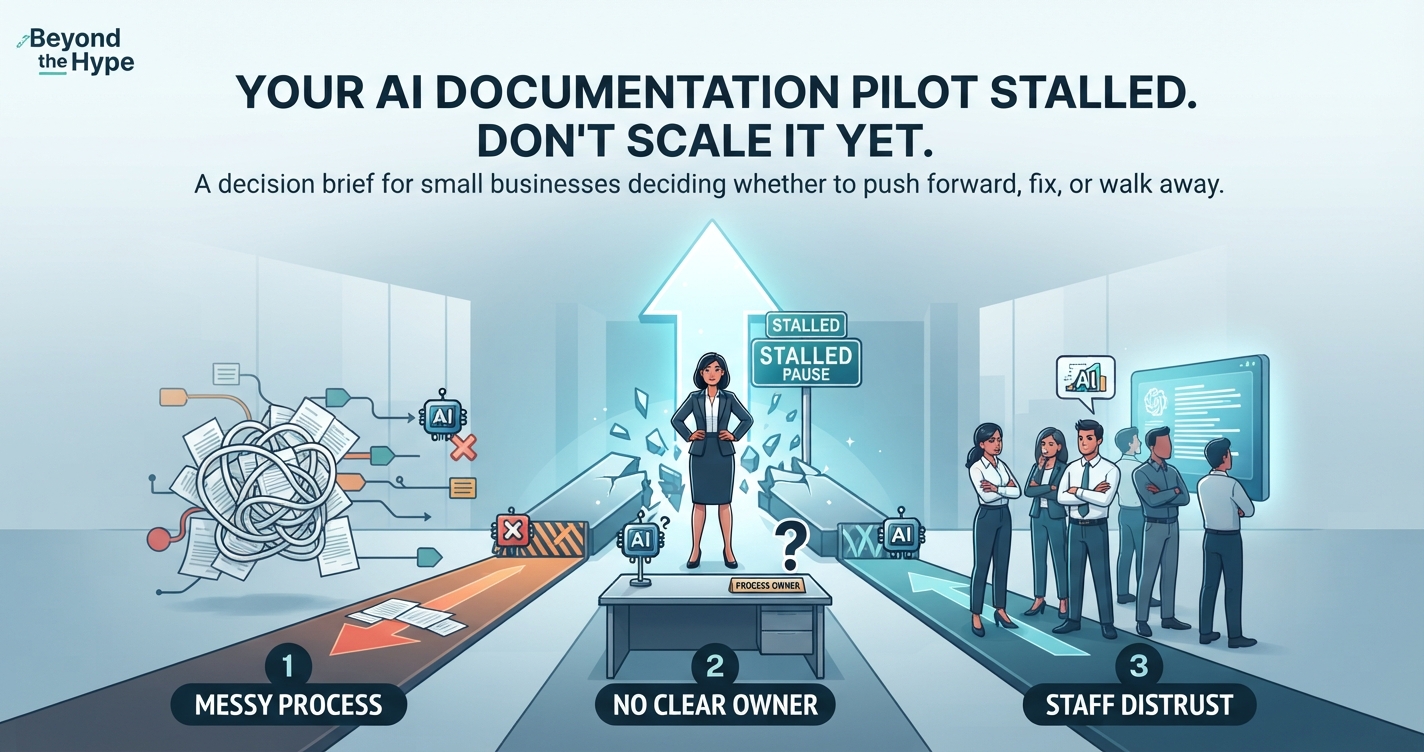
A stalled pilot is information, not a setback to push through. Most AI documentation pilots stall for reasons that have nothing to do with the AI model itself, usually messy source processes, no clear owner, or staff who don't trust the output enough to use it. Before you spend more money scaling, spend two weeks figuring out which of those three killed your pilot, because the fix is different for each one.
Decision: defer (confidence: 72%)
Scaling a pilot that stalled without diagnosing why is how small businesses turn a $3,000 experiment into a $30,000 sunk cost. Research on AI pilot failure consistently points to handoff problems between strategy, build, and daily operations rather than model quality, which means the fix is often organizational, not technical.
The business problem
The apparent problem looks like a tech problem: you tried an AI tool to write up your SOPs, it got partway through, and now it's sitting unused. The real problem is usually older than the pilot. Most small businesses that try AI documentation tools already had inconsistent, undocumented, or tribal-knowledge-based processes before anyone opened an AI dashboard. The AI didn't fail to write documentation. It failed to write documentation for a process that was never clearly defined in the first place.
This matters because the fix for "our AI pilot stalled" is completely different depending on whether the process itself was the problem or the tool was. Research on pilot failure backs this up directly: most AI pilots don't fail on the model, they stall in the handoffs between strategy, build, and operations, according to Why AI Pilots Stall Before Your Team Ever Uses Them. That's a structural, organizational failure, not a model quality issue.
A widely cited figure claiming 95% of AI pilots fail has circulated heavily, but the breakdown behind that number matters more than the headline. The report behind it points to unclear objectives, data readiness, and ownership gaps as the actual drivers, not AI capability itself, per Why AI pilots fail: the MIT report without the myths. If you're a 10-person team and your pilot stalled, the honest first move is asking whether you had a documented, repeatable process to feed the AI at all. If you didn't, no amount of scaling fixes that.
The AI option
Scaling the pilot is the path of least resistance. You've already paid for setup, maybe trained a few staff, and there's a natural pull to push through rather than admit the first attempt needs rework. That pull has a name: sunk cost bias, and it's one of the most common reasons flawed pilots get scaled instead of fixed, a pattern described clearly in Why AI Pilots Fail to Scale, which points to unclear objectives, poor data readiness, integration gaps, and weak ownership as the recurring causes.
Vendor pitches for AI documentation tools tend to promise things like seamless integration, no technical expertise required, and continuous accuracy improvements over time. Treat these as claims to test, not facts to plan around. "No technical expertise required" often means no coding, not no setup work; someone still has to feed the tool clean process inputs, check its output, and correct it when it drifts. "Continuous learning improves accuracy" sounds appealing but says nothing about who catches the mistakes in the meantime.
The AI option can work, genuinely, if three things are true: your source processes are already reasonably consistent, someone owns ongoing review and correction, and you've sized the real cost of that review time into your decision. Tools in this category are covered in Best process documentation software in 2026, which is worth reading for a vendor-neutral view of what these platforms actually do before you commit further budget. If your pilot stalled because staff didn't trust the output, more scaling just produces more untrusted output, faster.
Traditional automation option
Rule-based workflow automation, without any AI-generated content, can enforce review steps, flag stale documents, and route approvals automatically. This fits best when the real problem is follow-through and consistency rather than writing quality, for example if documents exist but nobody checks whether they're still accurate, or approvals stall in someone's inbox.
Low-code automation platforms can configure these workflows without heavy engineering work, though vendor claims of zero technical expertise should be tested against your actual systems before committing (kanerika). Licensing costs for rule-based tools are generally lower and more predictable than AI platforms since you're paying for workflow logic, not model usage, but get actual quotes rather than relying on list prices. This option doesn't fix messy source processes or missing ownership; it only fixes inconsistent process enforcement once the underlying content is already sound.
Process improvement option
In our assessment, when a documentation pilot stalls, the most common root cause isn't the tool, it's that the underlying process was never consistent to begin with. Running a short process mapping workshop with the staff who actually do the work, not just their managers, usually surfaces real inconsistencies: different people doing the same task different ways, steps that exist only in one person's head, or exceptions nobody wrote down. No tool, AI or otherwise, can document a process accurately if the people doing it can't agree on what the process is.
This option costs staff time rather than software budget, which makes it easy to underrate. Budget a few hours per relevant process for a structured walkthrough, followed by a written draft that the same staff sign off on before any tool touches it. If your pilot stalled because the AI's output felt wrong or unusable to staff, there's a reasonable chance the input process itself was the problem, not the drafting. This is editorial judgment based on common pilot failure patterns, not a cited statistic, but it's consistent with why pilots stall for reasons unrelated to the AI model itself.
Software configuration option
Between "buy more AI" and "do it all by hand" sits a large and often ignored middle option: configure existing, non-AI documentation software properly. Tools like structured wikis, SOP templates, and screen-recording capture platforms have existed for years and don't require any model training or data governance conversation at all. Business Process Documentation Tools: 18 Top Picks lists options such as Tango, Lucidchart, Process Street, Document360, and Confluence, all of which handle structured documentation without generative AI in the loop.
The appeal here is predictability. A template-based tool does exactly what you configure it to do, every time. It won't invent a step, misread a transcript, or drift in quality depending on the clarity of your input. If your pilot stalled partly because staff didn't trust what the AI wrote, a template-driven tool sidesteps that trust problem entirely, because a human wrote every word.
The tradeoff is speed on the front end. Configuring and populating a wiki or SOP template system takes real hours up front, usually more than an AI-assisted first draft. But it avoids the ongoing correction cycle that AI tools quietly add later. For low-complexity, stable processes (things that don't change often), this option tends to beat AI on total cost once you count review time honestly.
Human-led option
Assigning a dedicated documentation owner, even part time with protected hours each week, directly addresses a gap that no tool can fix on its own: nobody being accountable for keeping documentation accurate and current. In our assessment, this is often the real failure point behind stalled pilots that get blamed on the AI itself. A named owner interviews staff, maintains SOPs, and is the person staff go to when a document seems wrong, rather than that feedback disappearing silently.
The tradeoff is direct labor cost instead of software cost, and the benefit depends heavily on who takes the role and how much real time they're given. Part-time ownership that gets treated as a side task tends to fail the same way an unowned pilot does. If your diagnostic shows the stall was fundamentally an ownership gap rather than an output-quality gap, this option addresses the cause directly, whereas scaling the AI pilot without naming an owner would likely just reproduce the same stall at a larger scale.
Comparison criteria
Compare options against four criteria: cost, control, speed, and trust.
On cost, non-AI tools and traditional automation typically carry lower and more predictable licensing costs than AI platforms, though exact pricing varies by vendor and should be confirmed directly rather than assumed. On control, rule-based automation and human-led ownership give you the most predictable output, since nothing is generated that wasn't explicitly configured or written by a person. AI tools trade some of that predictability for drafting speed.
On trust, this is where AI options face a real and distinct question worth asking vendors directly: what happens to your process data, including any customer or operational details embedded in your SOPs, and is it used to train or fine-tune models beyond your own account? None of the non-AI alternatives raise this question, because they don't send your process data to a third-party model. Vendor claims of 'reduced human error' and 'scalability without added headcount' (gingersec) should be tested against your own pilot results, not accepted at face value, since these claims describe best-case conditions rather than guarantees.
On speed, AI drafting is fastest for first drafts, but that speed advantage shrinks or disappears once review and correction time is counted honestly against a measured manual baseline.
Recommended approach
Spend two to four weeks diagnosing why the pilot actually stalled before spending more money scaling it. Interview the staff who were supposed to use the AI-drafted documentation and ask directly: was the source process unclear or inconsistent, did nobody own keeping it updated, or did the output itself feel wrong or untrustworthy even after a fair trial? The fix is different for each answer, and scaling before you know which one applies risks compounding a process or ownership problem rather than solving it.
It's possible the diagnostic is inconclusive, for example if staff and management disagree about the root cause. If that happens, don't default to scaling the AI pilot to avoid the ambiguity. Instead, run the process mapping workshop first, since clarifying the underlying process is the lower-risk, lower-cost move regardless of which other factor turns out to be true, and it will make any later AI attempt more likely to succeed.
Before deciding, also check the cancellation and data-handling terms on the AI platform you already piloted, since those terms affect the real cost of pausing versus continuing. Once you have a clear diagnosis, pick the matching alternative: process improvement for messy inputs, a named owner for accountability gaps, or a second, smaller AI pilot with a committed reviewer if the process and ownership are already solid and the only issue was trust in a first draft.
Alternatives
AI option: Scale the existing AI documentation pilot after fixing whatever caused it to stall, with a named human reviewer checking every output before use.
Traditional automation: Use a rule-based workflow automation tool to enforce review steps, flag stale documents, and route approvals, without any AI-generated content involved. This fits best when the real problem is follow-through and consistency, not writing quality.
Process improvement: Run a short process mapping workshop with the staff who actually do the work to resolve inconsistencies before any tool touches the documentation. This is the strongest option when the pilot stalled because inputs were messy or contradictory, and it costs staff time rather than software budget.
Software configuration: Configure a non-AI documentation platform, such as a structured wiki, SOP template system, or screen-recording tool, to standardize how procedures are captured and stored. This favors predictability and staff trust over drafting speed.
Human-led: Assign a dedicated documentation owner, even part time, with protected hours each week to interview staff and maintain SOPs directly. This solves ownership gaps that no tool, AI or otherwise, can fix on its own.
Recommended: Process improvement first, paired with a non-AI software configuration option, unless the diagnostic clearly shows the stall was a reviewable AI output gap rather than a process clarity gap.
ROI Analysis
Baseline needed: Track how long it currently takes, in staff hours, to produce one accurate, usable piece of process documentation using your current (likely manual or ad hoc) method, before comparing it to any tool-based option.
Direct costs: Direct costs include any AI platform subscription fees already paid during the pilot, plus licensing costs for whichever non-AI tool you'd configure instead. Non-AI workflow and documentation tools generally run lower per seat than AI platforms, but get actual vendor quotes for your team size rather than relying on published list prices, since these vary widely.
Implementation costs: Implementation costs cover the setup time needed to connect a tool to your existing systems, since vendor claims of seamless integration rarely mean zero configuration work, especially for AI tools that need structured input data to perform well.
Training costs: Training costs include the hours needed to teach staff how to use whichever tool you choose and, more importantly, how to recognize when AI output needs correction, since untrained staff either over-trust or ignore AI drafts entirely.
Review costs: Review costs are the ongoing hours a human spends checking, correcting, and approving documentation output, which is often the most underestimated cost in AI pilots and the most likely reason a pilot stalls in the first place.
Adoption assumptions: Any ROI estimate assumes staff will actually use and trust the resulting documentation; if your pilot stalled due to low trust, that assumption doesn't hold and the projected time savings won't materialize regardless of tool choice.
Capacity impact: Consider whether scaling the AI pilot adds review workload to already-stretched staff, since a 10-person team rarely has spare capacity to babysit a tool, even one marketed as requiring no technical expertise.
Measurement period: Measure results over 60 to 90 days after any fix is applied, long enough to capture a few real documentation cycles but short enough to course-correct before sinking further budget.
Governance
Approved use: Define in writing which processes are approved for AI-assisted documentation (routine, non-sensitive tasks) versus which require human-only authoring (anything touching customer data, compliance steps, or safety procedures).
Data access: Confirm exactly what process data, including any customer or financial details embedded in your SOPs, is sent to the AI vendor's systems, and whether it's used for model training beyond your own account.
Human review: Require a named person to read and test every AI-generated procedure against the actual task before it's published, with sign-off recorded, not just a quick skim.
Escalation: Set a clear path for staff to flag an AI-generated document that seems wrong or unclear, routing to the documentation owner rather than being silently ignored or worked around.
Accountability: One role, not a committee, owns documentation accuracy and upkeep. Diffuse ownership is a common reason pilots stall at scale, not just at launch.